

Dana Rosingus has taught fifth grade at Gardnerville Elementary School in Nevada’s Carson Valley for more than twenty years. Her students call her Ms. Rose. Her colleagues describe her as the kind of teacher who reshapes her lessons around each kid. Not the curriculum, not the test, but the actual child sitting in front of her. For two decades, that’s what she did. She showed up.
Three years ago, she was diagnosed with Parkinson’s disease. Then, this April, a routine mammogram found something else. Not a lump. She describes it as “a bunch of sand pieces.” Breast cancer. A second diagnosis stacked on top of the first. She’s now on medical leave from the classroom she’s occupied for most of her adult life.
“Facing both of these things have been really challenging,” Rosingus said. And then she finished the sentence: “But the biggest thing is discovering this amazing team of support I have.”
That team made itself visible on Saturday.
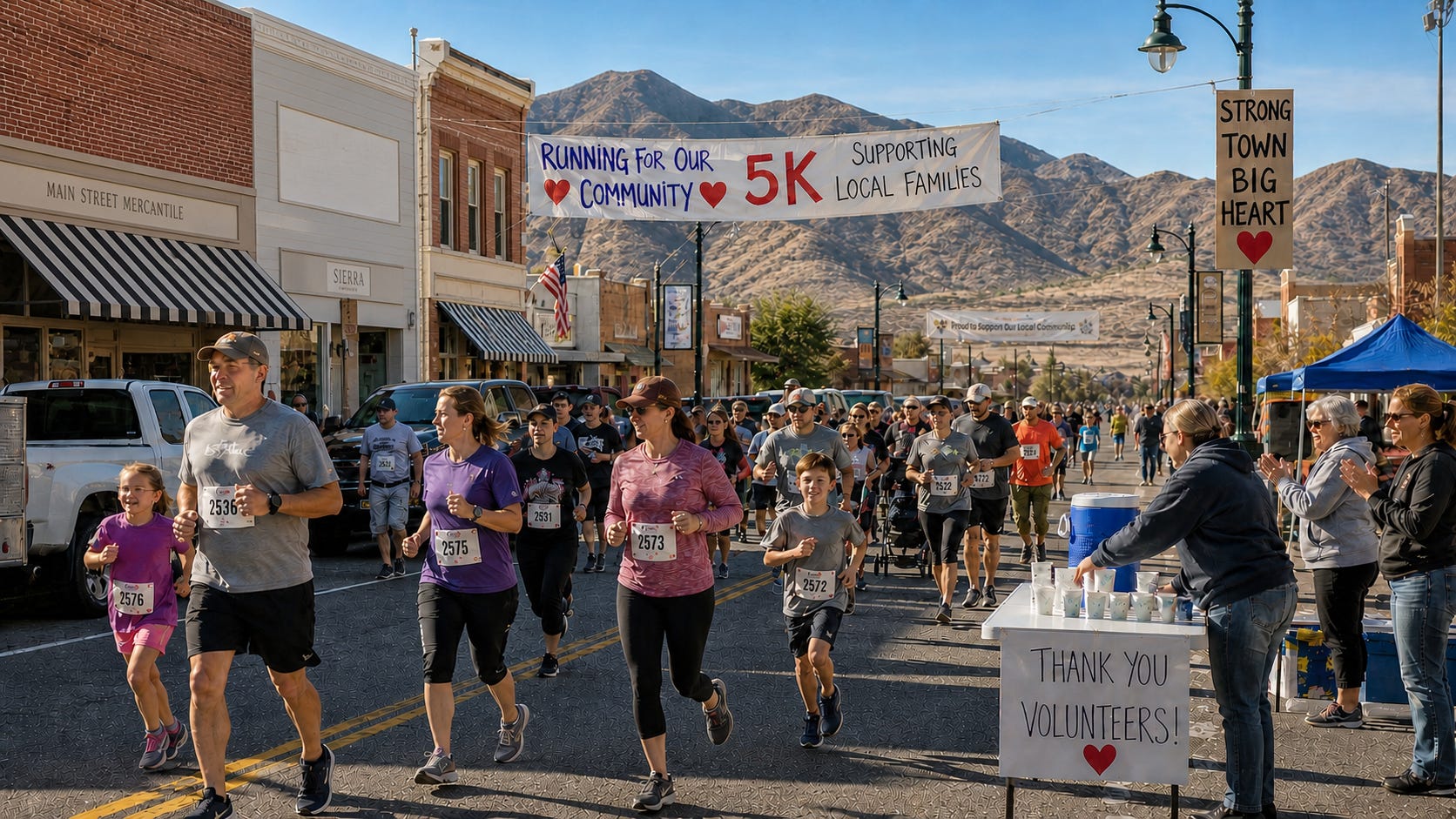
Joli McDuffee and Jenny McQain, friends of Rosingus, organized “Strength in Strides,” a fundraiser held at The Corner Bar on Esmeralda Avenue in Minden, just down the road from the school. A 5K run. A cornhole tournament. And a dunk tank staffed by people who know exactly who they were getting wet for: former student Nick Nalder. Retired Douglas County Sheriff’s Detective Jeff Schemenauer. Fellow Gardnerville Elementary teacher Amber Walling. All of them volunteering to take the fall, literally, for a woman who spent decades catching other people’s kids.
Robbi Jacobsen, who worked alongside Rosingus at Gardnerville Elementary for twenty-four years, put it plainly: “She is a gifted teacher who always puts her students first, individualizing their learning, according to what they need.” Then she added: “Dana is a believer in people.”
What strikes you about this story is the direction of the current. For twenty years, Rosingus poured into a community, into its children, into its families, into the kind of invisible labor that doesn’t make the news until someone can’t do it anymore. And when she couldn’t, the current reversed. Former students came back. Colleagues stepped up. Friends built an entire event from scratch. A retired detective sat in a dunk tank on a Saturday because a fifth-grade teacher mattered to the people around her.
Rosingus said something else worth sitting with. She said she’s been amazed by how many women have come forward to share their own breast cancer stories since her diagnosis became public. “They’re like unsung heroes,” she said, “because many women deal with breast cancer privately, but many have opened up and shared how they dealt with it during this difficult time.”
That’s what solidarity does when it works. It doesn’t just help one person. It opens a door, and others walk through it, carrying their own weight, finding their own voice, realizing they don’t have to do it alone either.
“They’ve helped me in knowing that I don’t have to face these challenges alone,” Rosingus said.
None of us do. That’s a promise a community makes when it shows up. Not once, not as a gesture, but as a reflex. The kind of promise you keep by keeping it.
Together
.