


You know how it works. You sign up for the thing. The headline promise is beautiful. Freedom, in this case. Then somewhere below the fold, in type small enough to skip, the company takes back what the headline gave you.
Every contract has fine print. So does the Constitution.
The 13th Amendment is the one we celebrate. Ratified in 1865, it abolished slavery in the United States. That is what the headline says, and the headline is what we teach children. But the amendment is fifty-three words long, and thirty-two of them are an asterisk:
“Neither slavery nor involuntary servitude, except as a punishment for crime whereof the party shall have been duly convicted, shall exist within the United States.”
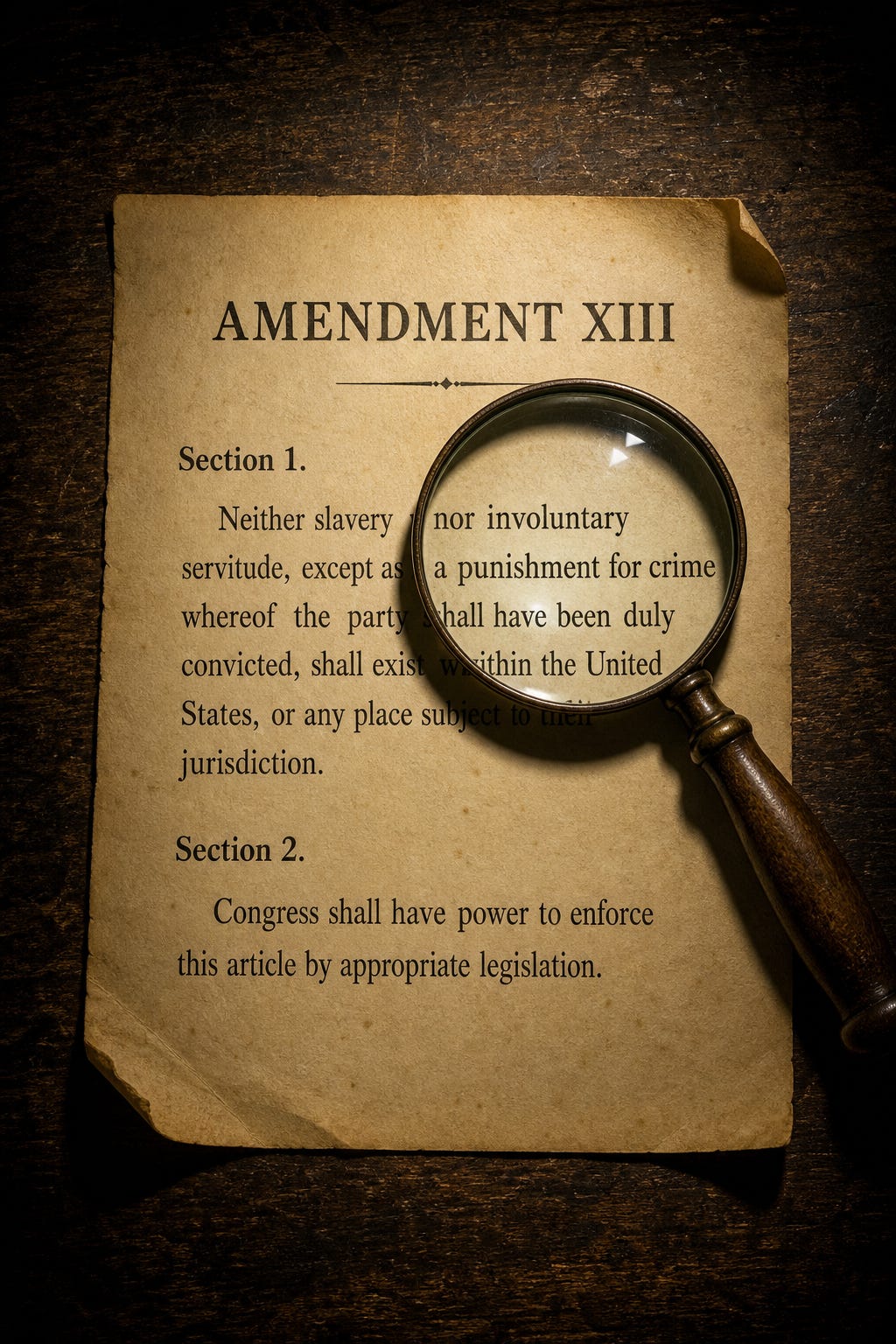
Except.
That single word did not end slavery. It rebranded it. It moved slavery from the plantation ledger to the criminal docket and called the transfer abolition. Within a generation, Southern states had written Black Codes to criminalize existence itself, then leased the newly convicted back to the same fields they had supposedly been freed from. The product never left the shelf. Only the label changed.
Here is what the fine print looks like today.
Roughly 800,000 incarcerated people work inside American prisons right now. They cook the food, staff the laundries, fight the wildfires, manufacture the license plates and office furniture, and clean the very cages they sleep in. Their labor produces at least two billion dollars in goods and another nine billion in prison maintenance services every year. For this, most states pay between fifteen and fifty-two cents an hour. Seven states pay nothing at all for the majority of prison work. Alabama. Arkansas. Florida. Georgia. Mississippi. South Carolina. Texas. Zero dollars. Refuse the work and the menu of consequences includes solitary confinement, loss of family visits, and denial of parole.
Work you cannot refuse, for wages that round to zero, under threat of punishment. There is a word for that arrangement, and the Constitution uses it. The exception clause is not a loophole that bad actors exploit. It is a license, and the largest license holder is the government itself. Your state very likely runs on this labor. Your license plate may have been made by it. If you live in California, the person who defended your neighborhood from wildfire may have earned a few dollars a day to risk her life doing it.
Then there is the industry that grew up around the license. Private, for-profit prison corporations hold about ninety thousand human beings across twenty-seven states and the federal system. Their business model is arithmetic: every occupied bed is revenue, every empty one is loss. A company whose earnings depend on incarceration does not lobby for healing. It lobbies for supply. The state built the machine. The market simply figured out how to sell tickets.
Now look at what the machine produces, because this is where the moral argument becomes a practical one.
Sweden treats a prison sentence as the punishment itself. The deprivation of liberty is the debt. Nothing further is extracted. The Swedish Prison and Probation Service refers to the people in its custody as clients, houses them in conditions built to resemble ordinary life, and spends the sentence on education, treatment, and work that pays. That agency reports its emphasis on rehabilitation cut reconviction from 42 percent to 29 percent over sixteen years. Sweden has closed prisons for lack of demand.
The United States runs the opposite experiment, and the results are in. Federal data tracking people released from state prisons found 68 percent were rearrested within three years. Within nine years, 83 percent. Measure it however you like; no honest reading of those numbers says the system is working. We take people at their most broken, cage them, extract their labor, return them to the street with nothing, and then act surprised when the door revolves.
It is not surprising. It is the design. A system that profits from bodies has no incentive to release whole human beings. In that business model, recidivism is the subscription renewal. A healed citizen is churn.
Here is the thing the fine print wants you to forget. The people inside are citizens. Most of them are coming home, to your block, your grocery store, your kid’s school parking lot. The only question is what condition they come home in. You can receive a neighbor who spent five years learning a trade, treating an addiction, and rebuilding a self. Or you can receive one who spent five years being warehoused and worked like equipment. You will live next to the output either way. Choose the output.
So read your own state’s terms and conditions. More than a dozen state constitutions still contain the exception in some form. Colorado struck it in 2018. Alabama, Oregon, Tennessee, and Vermont followed in 2022. California voters declined in 2024, which means this fight is live and losable. Find out where your state stands. If the clause is still there, tell your legislators you want it gone, and say the word slavery when you do, because that is the word the Constitution uses. At the federal level, the Abolition Amendment to strike the exception clause has been introduced in Congress repeatedly. It dies quietly every session because nobody with power believes anybody is watching.
Watch.
We are the only country that wrote abolition with a receipt for repossession stapled to the back. We can be the generation that finally reads the whole document, takes out a pen, and deletes the asterisk.
Together.
Sources
Bureau of Justice Statistics, “2018 Update on Prisoner Recidivism: A 9-Year Follow-up Period (2005-2014)” — https://bjs.ojp.gov/library/publications/2018-update-prisoner-recidivism-9-year-follow-period-2005-2014
ACLU and University of Chicago Law School Global Human Rights Clinic, “Captive Labor: Exploitation of Incarcerated Workers” — https://www.aclu.org/publications/captive-labor-exploitation-incarcerated-workers
ABA Journal, “Behind Bars in Scandinavia, and What We Can Learn” — https://www.abajournal.com/magazine/article/behind-bars-in-scandinavia-and-what-we-can-learn
The Sentencing Project, “Private Prisons in the United States” — https://www.sentencingproject.org/reports/private-prisons-in-the-united-states/
University of Chicago News, “Rethinking Prison Labor Under the 13th Amendment” — https://news.uchicago.edu/story/rethinking-prison-labor-under-13th-amendment
Related Reading
Captive Labor: Exploitation of Incarcerated Workers (ACLU / UChicago Law) — the definitive report on who works, what they earn, and what happens when they refuse https://www.aclu.org/publications/captive-labor-exploitation-incarcerated-workers
Behind Bars in Scandinavia (ABA Journal) — inside the Swedish and Norwegian facilities that treat sentences as rehabilitation https://www.abajournal.com/magazine/article/behind-bars-in-scandinavia-and-what-we-can-learn
Private Prisons in the United States (The Sentencing Project) — the state-by-state map of for-profit incarceration https://www.sentencingproject.org/reports/private-prisons-in-the-united-states/
2018 Update on Prisoner Recidivism (Bureau of Justice Statistics) — the nine-year federal data behind the 68 and 83 percent figures https://bjs.ojp.gov/library/publications/2018-update-prisoner-recidivism-9-year-follow-period-2005-2014