

You’re sitting in a meeting and something shifts.
The conversation you prepared for, or rather, the conversation you were told required no preparation, isn’t the conversation happening. The person across from you is asking for a presentation you don’t have, referencing criteria you’ve never heard, evaluating you against a rubric that everyone else apparently received days ago.
So you do what anyone would do: you scroll back through your emails, looking for what you missed.
And you find nothing wrong.
Every word checks out. Every sentence is technically true. Not a single promise was broken, because not a single promise was made.
That’s when you realize: the problem was never what they wrote. It was what they didn’t.
Anatomy of a Carefully Worded Email
There’s a genre of workplace communication that doesn’t lie to you. It does something more sophisticated than that; it constructs a world made entirely of true statements in which you are guaranteed to make the wrong assumption.
You’ve received these emails. Everyone has. They come before meetings that turn out to be evaluations, before “conversations” that turn out to be terminations, before “check-ins” that turn out to be investigations. They are written by people who know exactly what’s about to happen and have chosen, with great care, not to tell you.
The defining feature of the carefully worded email is that it withstands rereading. You can go back to it a hundred times and never find the sentence that misled you; because the mechanism isn’t deception. It’s omission with architecture.
Here’s how it works.
Someone emails you about a project. A quick 20-minute discussion, nothing major - just an update on where things stand.
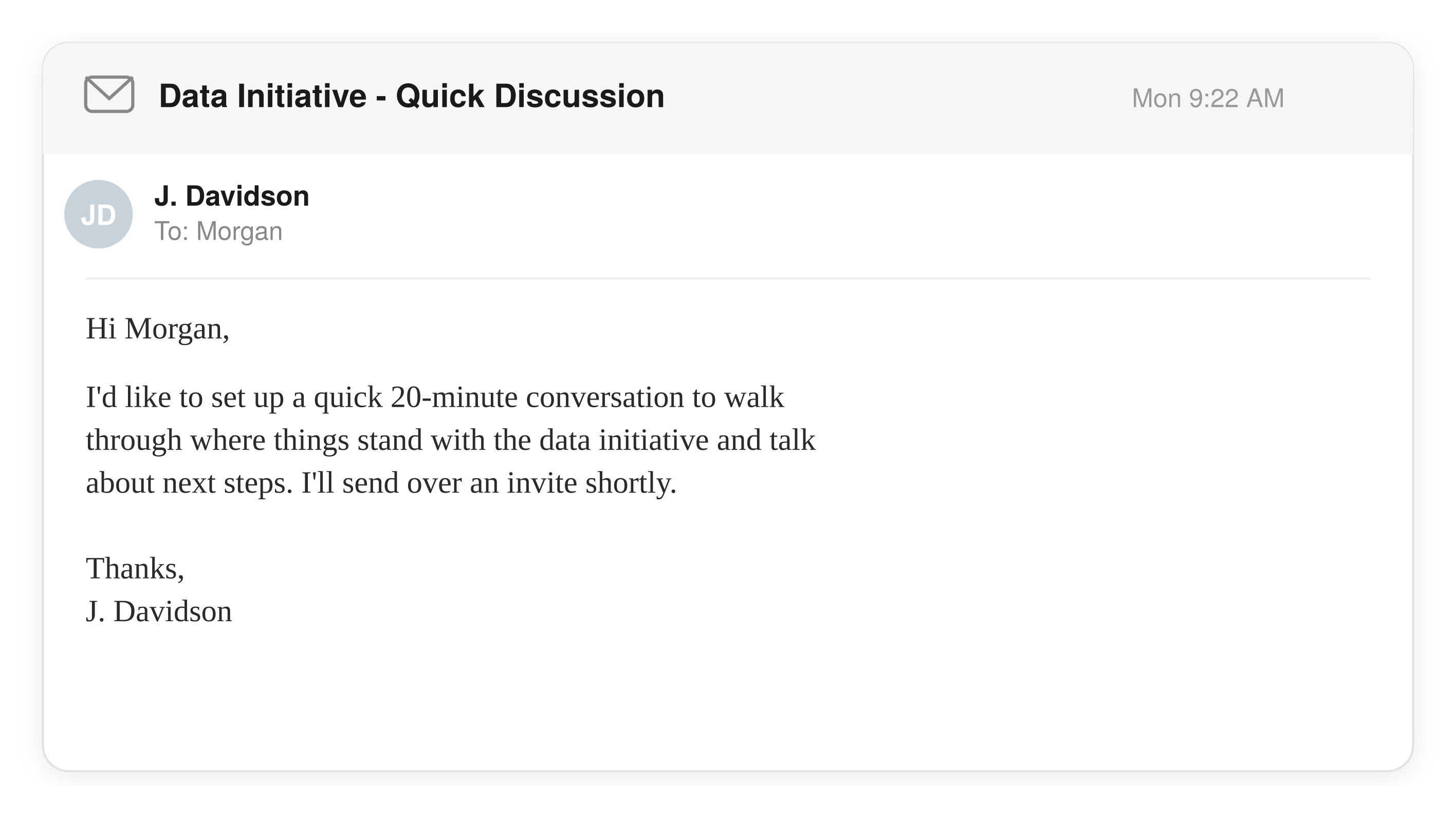
Simple enough. So you reply. You express your interest. You put yourself forward.
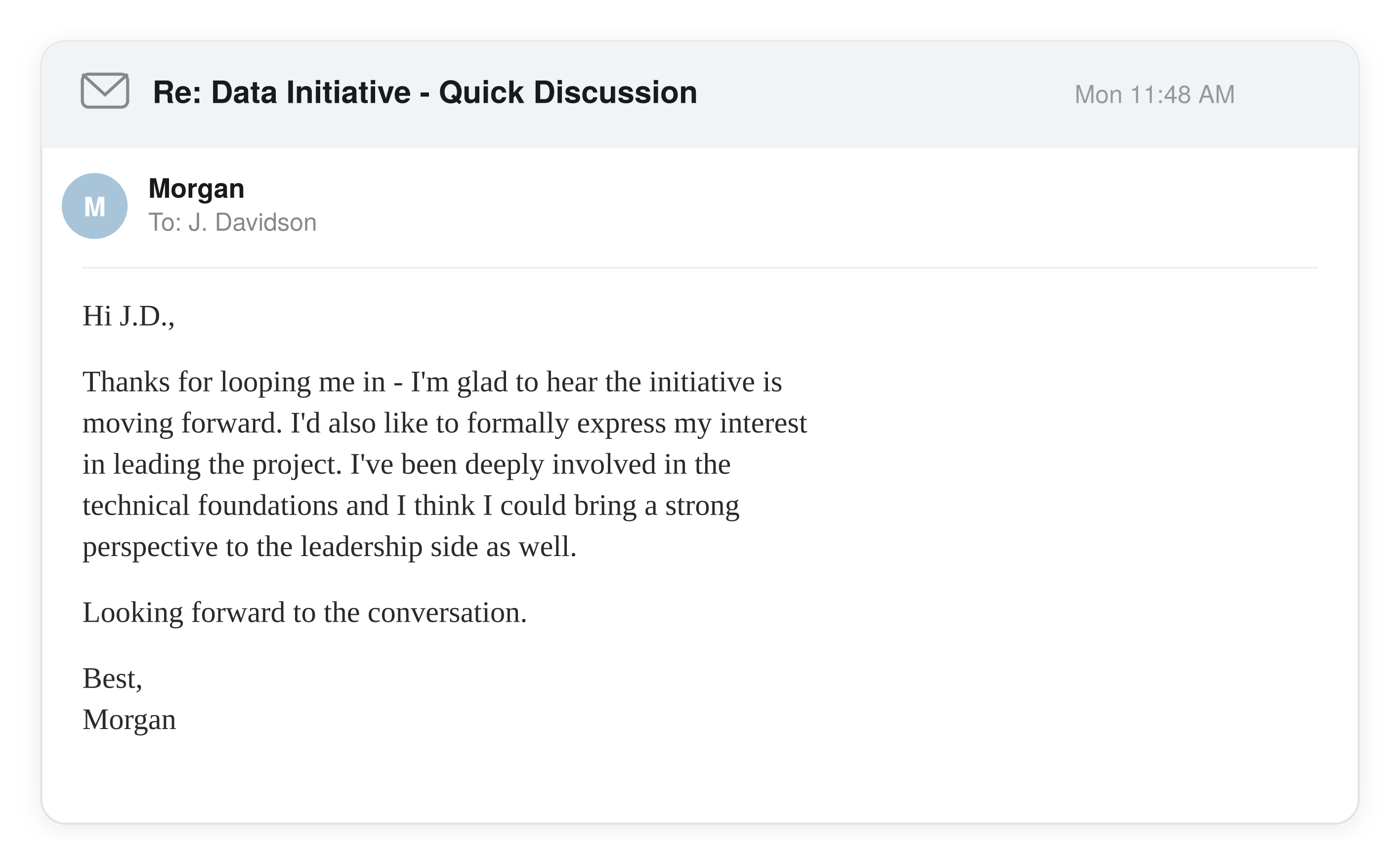
And you wait. When the response comes, it’s short. Almost conspicuously short. The one thing it doesn’t do is answer your question, it just redirects you to the meeting that was already scheduled.
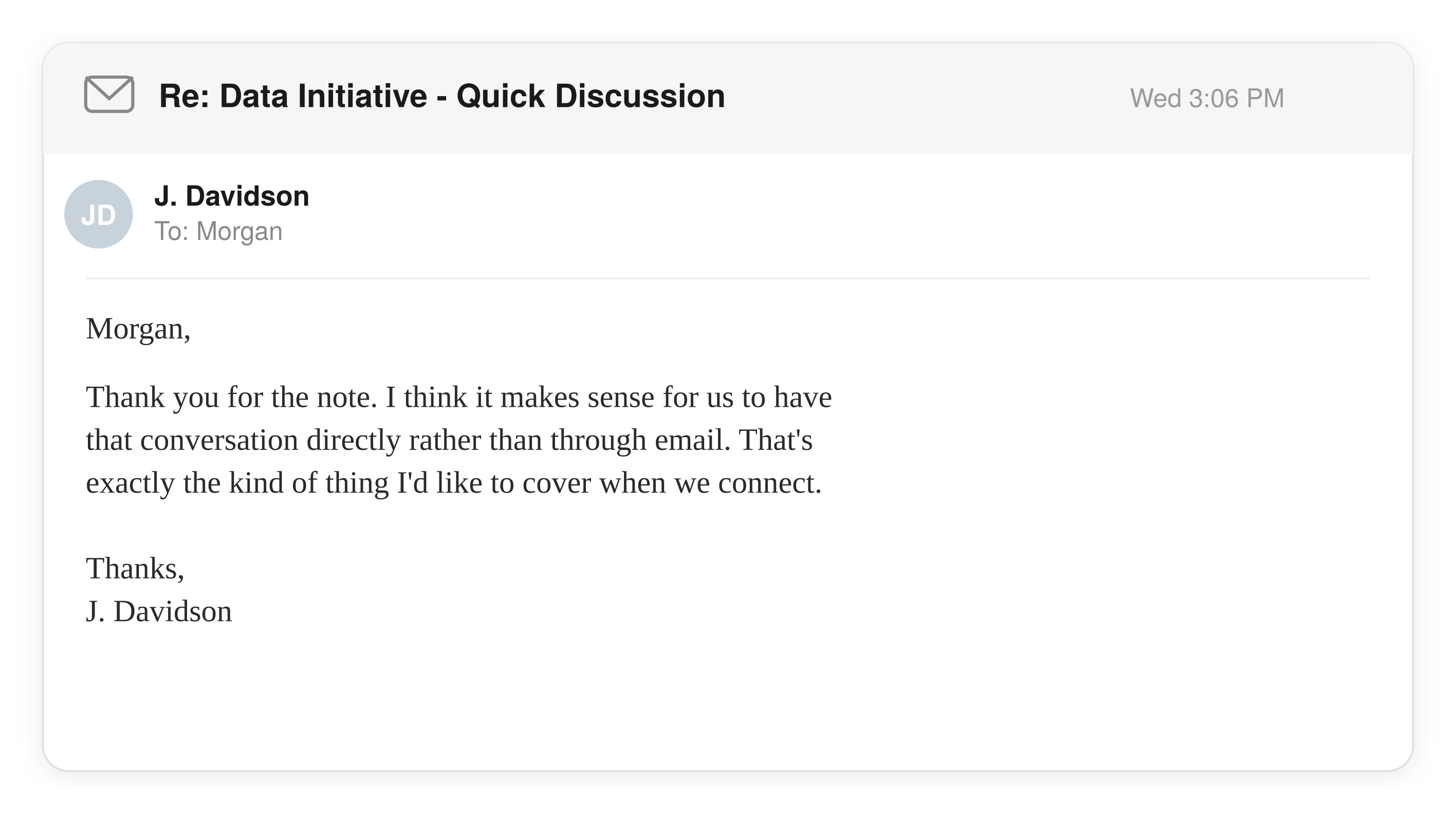
Notice what’s missing.
Then comes the email that does the real work. The meeting triples in length. Topics appear. Specificity increases. The language shifts from casual to structured. Every signal says this is getting more serious, this matters, something is being decided. And buried in the middle of it, a sentence that will matter more than any other in the entire chain:
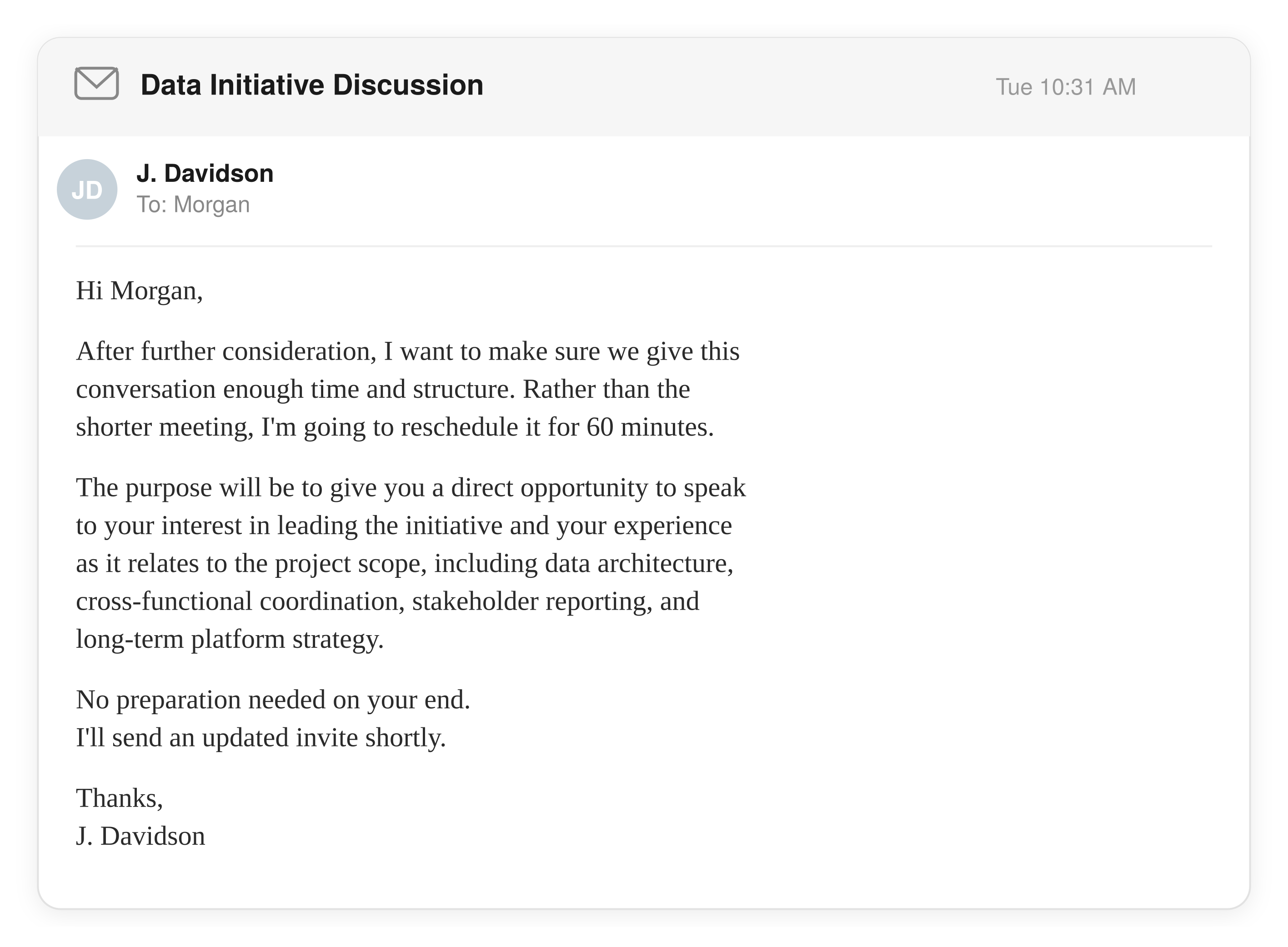
No preparation needed on your end.
Read that email again. Count the topics listed. Count the competencies implied. Count the evaluation criteria that would be obvious to anyone designing an interview.
Now count the number of times it tells you this is an interview.
Again, notice what’s missing.
The Vocabulary of Withholding
Most people can feel when they’ve been handled by a carefully worded email, but they can’t name what was done to them. That’s by design, and the technique works precisely because there’s no single moment to point to. But the moves have names, even if no one’s taught you what they are.
The non-retraction. An earlier instruction - “no preparation needed” - should logically be updated given what the sender now knows the meeting will require. It isn’t. Not because they forgot, but because updating it would constitute notice, and notice is what the architecture is designed to avoid. The original instruction ages quietly in the thread, doing its work.
The deflection. When the recipient asks a direct question - expressing interest, requesting information - the reply redirects to the meeting rather than answering in writing. “I think it makes sense for us to have that conversation directly rather than through email.” This sounds collaborative. It’s actually a containment strategy: nothing evaluative goes in writing, because writing creates a record of what was disclosed and when.
The topic-without-format. You’re told what will be discussed. You’re never told how you’ll be evaluated on your ability to discuss it. The email lists subject areas - “data architecture, cross-functional coordination, stakeholder reporting” - which reads like an agenda. It’s actually a rubric. But calling it a rubric would be telling you what the meeting is, and that’s the one thing every email in the chain avoids.
The consistent renaming. The same event gets called “a conversation,” “a discussion,” “an opportunity to speak to your interest.” Each is technically accurate. None is the word that would have changed how you showed up.
If you’ve felt the disorientation of rereading a chain of emails and not being able to find the lie, you weren’t failing to read carefully enough. You were reading an email that was written more carefully than you were meant to notice.
Why It Works
The carefully worded email works because it exploits a reasonable person’s good faith.
When someone tells you no preparation is needed, you believe them - not because you’re naive, but because that’s how communication is supposed to work. Workplaces function on the assumption that when your manager writes you an email, the email means what it says. The carefully worded email weaponizes that assumption. It relies on the recipient reading normally while the sender writes strategically.
And it has a built-in defense.
When the recipient later objects - when they say I didn’t know this was an evaluation, I didn’t know I needed a presentation, I didn’t know the criteria - the sender can point to every email in the chain and say: “Show me where I misled you.”
And you can’t. Because they didn’t.
What they did was not tell you the one thing that would have changed everything, while telling you everything else with increasing specificity and warmth. The architecture is designed so that the absence is invisible - surrounded by so much language that it feels like information, when it’s actually insulation.
The answer to “show me where I misled you” is: “You misled me by not saying the thing that would have changed how I showed up.” That’s hard to articulate, harder to prove, and nearly impossible to explain to someone who isn’t already sympathetic.
Which is exactly the point. The design is deniability.
The Interview That Never Was
Here’s what it feels like from the inside.
You walk into a meeting you prepared for as a conversation. You’re dressed professionally, because you always are. You have your notes, because you always do. And four minutes in, someone across from you shifts the frame. The conversation you expected to have is now an evaluation you didn’t know was happening. Criteria you’ve never seen are being applied to answers you’re giving in real time. Presentation formats you didn’t know existed are being offered; whiteboard, slides, screen share, as though choosing between them is a courtesy rather than a revelation.
And then comes the sentence that changes the geometry of the room:
“I’ve given that same briefing to everyone I’ve interviewed.”
Everyone. Meaning: they knew. The format, the criteria, the evaluation rubric, the option to prepare a deck - everyone else received all of it, days before they walked in. You received it four minutes after you sat down, in a meeting you were told required no preparation, under a calendar invite that still said “discussion.”
You spend the next hour performing extemporaneously against people who rehearsed. You do well - maybe better than you have any right to, given the conditions. You stand behind your answers. You keep your composure. You close gracefully. And when it’s over, you sit in the quiet and realize: the gap between your performance and a prepared candidate’s isn’t knowledge, or judgment, or capability. It’s the forty-five seconds of pre-packaging that everyone else was given time to build.
You were meant to walk in unarmed. That’s what the emails were for.
And then the final email arrives:
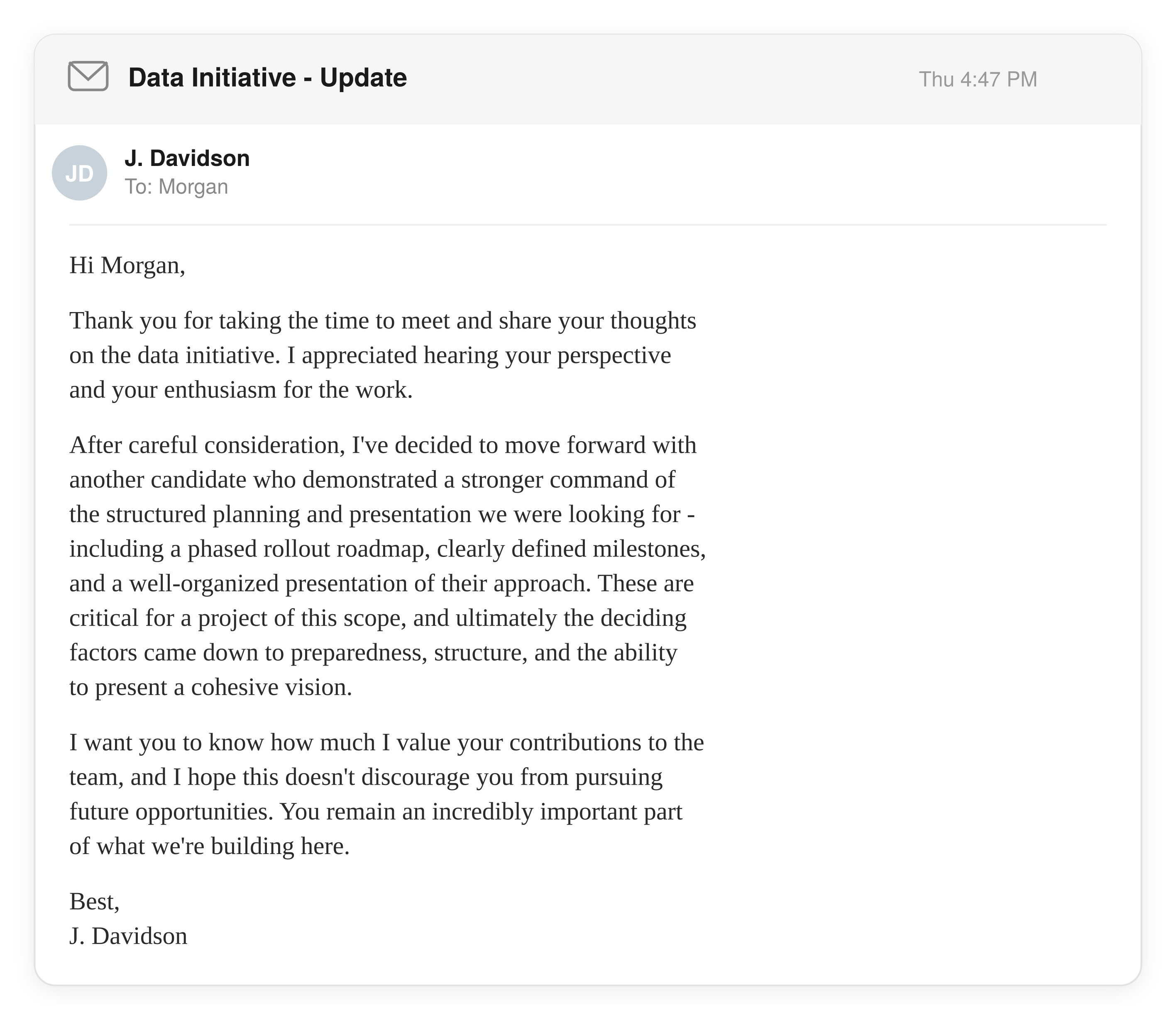
Read it carefully. Every criterion named as the deciding factor - preparedness, structure, presentation, a phased roadmap with milestones - was withheld across four prior emails. “Preparedness” was explicitly waived. “Structure and presentation” were never mentioned as evaluation criteria. “A phased roadmap” was never requested.
And the closing line: “I hope this doesn’t discourage you from pursuing future opportunities. You remain an incredibly important part of what we’re building here.”
The architect of the disadvantage offering encouragement. The person who told you not to prepare rejecting you for not being prepared. And you’re supposed to say thank you.
Now reread emails 1 through 4.
How to Read the Architecture
Once you know what a carefully worded email looks like, you can’t unsee it.
When you receive a workplace communication about a significant meeting, event, or decision, run this diagnostic:
What is this meeting called? Is it called the thing it actually is? Or is it called something adjacent - a “discussion,” a “conversation,” a “check-in” - that could be the thing, or could be something softer, and the ambiguity is doing work?
When you asked a direct question, did you get a direct answer - or a redirect? “Let’s discuss that in person rather than over email” sounds reasonable. But if the thing being deferred is the information you’d need to show up prepared, the redirect is functional, not collaborative.
If the sender described the format, did they describe the expectations? There’s a difference between telling you what will be discussed and telling you how you’ll be measured against your ability to discuss it. Topics without criteria is a meeting. Topics with hidden criteria is an audition.
Is there an earlier instruction that should logically have been updated given what you now know - and wasn’t? This is the ghost in the machine. “No preparation needed” is a perfectly normal sentence in a perfectly normal email. It becomes something else entirely when the meeting it precedes turns out to require exactly what it told you not to bring.
If the answer to any of these questions is no, you may be reading a carefully worded email. And the thing it didn’t say is probably the thing you needed most.
What You Can Do
Name it. To yourself first, then to someone you trust. The disorientation you felt wasn’t confusion, it was the correct response to language that was built to confuse you. You read every email accurately. The problem is that every email was written to be read accurately and still leave you unprepared.
Save everything. The chain, the calendar invites, the timestamps, the subject lines. Carefully worded emails are designed to survive rereading, but they aren’t designed to survive sequencing - laid end to end, with dates attached, the architecture becomes visible. The pattern that’s invisible in any single email reveals itself across five.
And know this: if you’re sitting in your car after a meeting, scrolling back through emails trying to find the thing you missed - you probably didn’t miss anything. Something was kept from you, carefully.
You’re not bad at reading emails. You’ve simply encountered someone who is very good at writing them.
If this resonated, share it with someone who needs the vocabulary.
And if you’re building the courage to name what happened to you - I see you. You don’t have to do this alone. We do this...
Together.
Resources
Workplace Fairness - Plain-language explanations of employee rights organized by topic: hiring, promotion, retaliation, whistleblower protections, and more. One of the best “I just want to understand what applies to me” starting points.
Find your people:
Ask A Manager - Alison Green’s site is where millions of people have gone to say “is this normal?” about their workplace and gotten honest, experienced answers. If you’re still in the “am I overreacting?” stage, start here.
together.love - You’re already here. Stay. This is a community for people who’ve been through it and people who are in the middle of it, and both are welcome.
Read deeper:
The Memo by Minda Harts - Navigating workplace politics, advancement, and systemic barriers, written for women of color but relevant to anyone who’s been sidelined by systems they couldn’t see.
Crucial Conversations by Patterson, Grenny, McMillan, and Switzler - Practical frameworks for high-stakes conversations where emotions are high and power dynamics are real.
Dare to Lead by Brene Brown - Less about the problem and more about what leadership should look like, which is useful when you need a reminder that what you experienced isn’t how it’s supposed to work.
Talk to someone:
If what you’re carrying is affecting your sleep, your health, or your ability to function, that’s real and it matters.
988 Suicide and Crisis Lifeline - Call or text 988. Available 24/7.
SAMHSA Helpline - 1-800-662-4357. Free, confidential, 24/7 referrals.
Open Path Collective - Affordable therapy sessions ($30-$80) for people without adequate insurance coverage.
Psychology Today Therapist Finder - Searchable by location, specialty, and insurance. Filter for “workplace issues” or “stress” if you’re not ready for more specific terms.