

A note before we start: this happened almost forty years ago, and I don’t condone pouring liquid on anyone. The bottle is a metaphor. Use your words. That’s the whole point of this piece. I found a way to do exactly that as an adult, and it’s all there below.
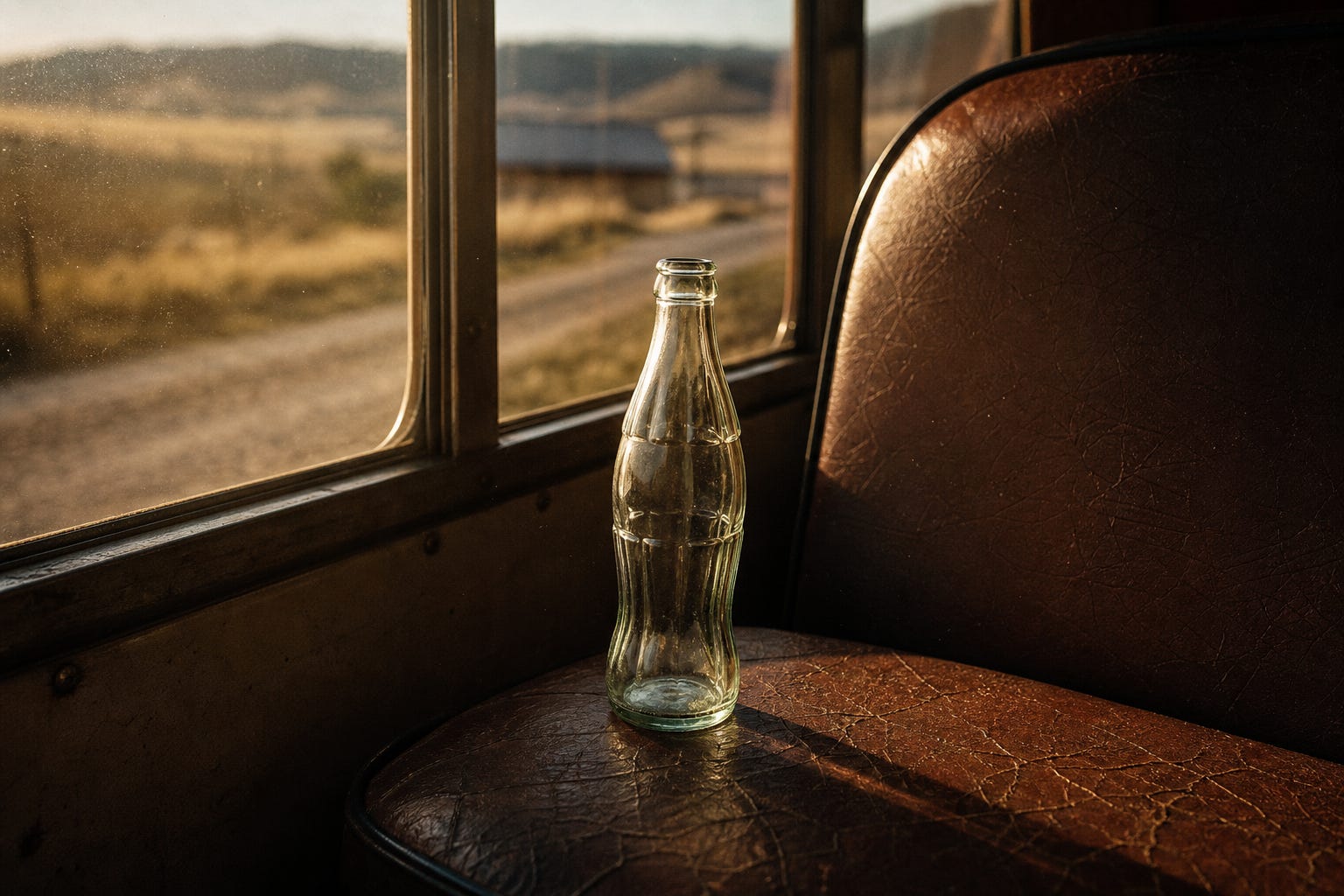
We lived at the end of a mile of gravel road. That last day of ninth grade, the bus rattled down it the way it had for five years, dust rising behind us like a curtain closing, and the boy I’d once had a crush on turned around in his seat and held out what was left of his Coke.
“Want the rest?”
You have to understand what that offer meant. Five years earlier, two boys stopped by our new farm to say hello, went to school, and decided for everyone that I was not one of them. That was the whole trial. I was never in the room for it. For five years of a small school's long memory, I was outside the circle, the girl it was safe to be cruel to, because the verdict had been handed down before I ever walked through the door. And now, on the last ride of the last day, a bottle held out across the aisle like a small treaty. You're worthy after all.
I said yes. Of course I said yes. I took a drink, maybe two.
And somewhere in that second sip, three facts lined up like tumblers in a lock: I was almost home. We were moving in three weeks. I would never be on this bus again.
The bus had no more power over me. Nobody did.
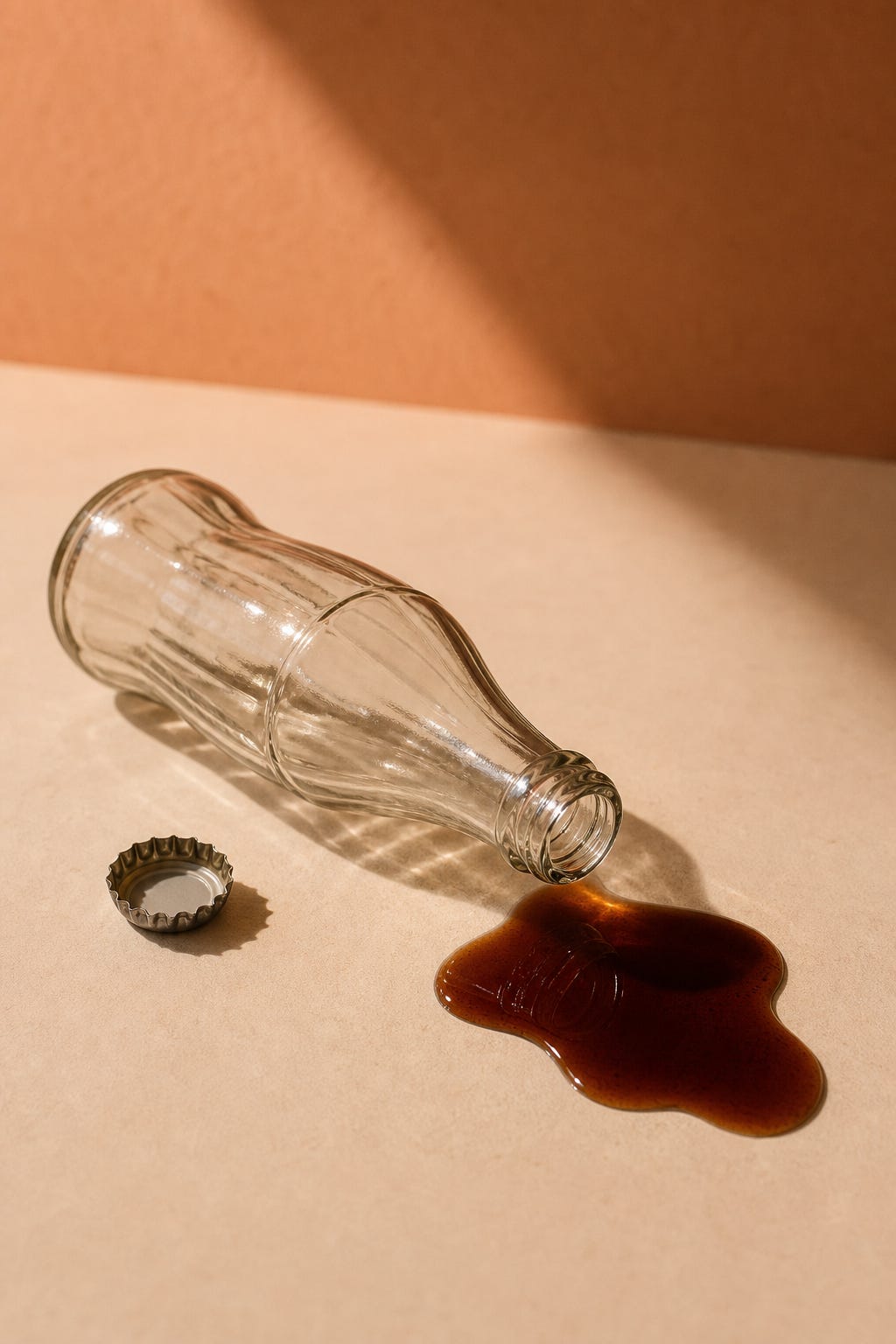
I unscrewed the cap, walked up the aisle, and knelt on the seat in front of one of the boys who’d started it all, and the girl beside him, a bully of the dedicated variety. I looked at them both and asked, sweet as anything, “Hey, would you like to have some soda?”
They said yeah.
I poured it over both their heads. “This is for everything you did to me. This is for the last five years.”
The girl screamed. She had no idea why it was happening. She never connected her cruelty to any consequence, and I suspect she never has. But the boy didn’t scream. He just looked at me, dripping, unhappy, and completely silent.
Because he knew.
The bus driver pulled over, right in front of my house, as it happened. “Did you just do that?”
“Yep.”
“You’re off the bus the first week of next year.”
“No, I’m not. We’re moving.”
And I walked down my driveway and went home.
I’ve thought about that bottle for almost forty years, because it turned out to be a template I would need again and again. Here is what most people believe about speaking truth to the people and institutions that have wronged them: they believe there are two options. Silence or the grenade.
Silence is the popular one. Keep your head down, stay professional, get out clean, say nothing. Silence protects you, and it changes nothing. The people who hurt you learn that hurting you is free. The institution learns that its patterns work. You carry the unsaid thing out the door with you, and it rides along for years.
The grenade is the other one. Blow it all up on the way out. The reply-all, the scorched-earth speech, the burned bridge. The grenade feels righteous for about eleven seconds. Then the story stops being about what they did and becomes about how you reacted. You hand them, at the last possible moment, the only thing they never had: a legitimate grievance against you.
But there is a third option. I learned it at fourteen years old with my knees on a bus seat, and I have used it my whole life since.
As an adult, the bottle stopped being soda a long time ago. Now it’s words. Carefully measured, perfectly professional, delivered at the moment they can no longer be punished, to the person who most needs to hear them. Nothing any policy can touch. No insubordination. No outburst. No grenade. Just a mirror, held perfectly steady, at exactly the moment it can no longer be knocked from my hands. I have watched people go red and look at the floor in front of that mirror. Not because I raised my voice. Because I didn’t.
That’s the third option. That’s the Coke bottle.
The bottle has rules. I didn’t invent them; I discovered them, the way you discover the rules of anything true.
You wait until the pour can’t be punished. Fourteen-year-old me didn’t pour in year one. That would have bought five more years of escalation. She poured when the bus was stopped in front of her own house. Timing isn’t cowardice. Timing is jurisdiction.
Your own conduct stays spotless, before and after. The pour only works if there’s nothing else in the story. The moment they can point at your behavior, the truth you told becomes the tantrum you threw.
You offer before you pour. “Would you like to have some?” I have never delivered a hard truth that didn’t come wrapped in genuine respect, real professionalism, an actual gift. Not as camouflage. As covenant. The offering is what makes the truth land as truth instead of attack.
You own it when they ask. Did you just do that? Yep. No denial, no shuffle, no “that’s not what I meant.” The pour is only powerful if you stand in it.
And you accept that some of them will never know why. The boy knew. The girl screamed, soaked and baffled, cruelty and consequence never once connecting in her mind. You don’t pour to make them understand. Understanding is theirs to find or refuse. You pour because the bottle is yours, the truth is yours, and carrying it home unspoken was never an option.
Here’s the last thing, and it’s the part that keeps the third option honest.
Coke washes out.
It’s sticky. It clings. For a minute, everyone can see exactly what happened. And then: soap, water, done. Nobody is scarred. Nothing is burned down. What was poured wasn’t acid and was never meant to be. It was meant to wake, not to wound. Whether they stay awake afterward is entirely up to them; that part was never yours to control.
And that's the standard for the only thing I am telling you to pour: words. The soda was a fourteen-year-old's version. The adult version has never needed a bottle. Truth, carefully measured, delivered clean, washes out the same way. It stings for a minute. It doesn't scar. It wakes.
So if you’re sitting on a bus right now, in an office, in a family, in any institution that spent years teaching you that your voice was the price of belonging, and you can feel your stop coming up ahead, know that you don’t have to choose between swallowing it and going nuclear.
There is a third option.
Unscrew the cap. Ask them if they’d like to have some. Tell the truth with your knees on the seat and your house in sight.
Pour out your carefully measured words.
And then walk down your own driveway, into the place that’s yours, with an empty bottle and nothing left uncarried.
Someone you love is still on their bus. Show them the third option and help them to pour their words...
Together.
Related Reading
The Carefully Worded Email — the pour in written form
The Playbook — what institutions do when you speak; the counterpart to knowing when
The Self-Worth Epidemic — where the cruelty on that bus actually comes from
The Borrowed Floor — another cautionary tale about consequences arriving on schedule
Resources
If this piece named something you’ve been carrying, here are places to build the skill of pouring words instead.
The classic on tactical communication, written by an English professor turned street cop who spent a career talking people down instead of taking them down. His line could be this article’s thesis: when you react, the event controls you; when you respond, you’re in control. Verbal Judo: The Gentle Art of Persuasion by George J. Thompson — https://www.goodreads.com/book/show/865508.Verbal_Judo
A practical method for staying centered when someone comes at you, built on three moves: accept, redirect, reaffirm. They run free monthly introductory sessions online. Verbal Aikido — https://portal.verbalaikido.org/
The formal discipline of measured words: observe without judging, name the feeling, name the need, make the request. Nonviolent Communication: A Language of Life by Marshall Rosenberg — https://en.wikipedia.org/wiki/Nonviolent_Communication
If speaking up in the room is the muscle you want to build, this is the gym. Over 14,000 clubs worldwide, visiting is free, and nobody makes you talk until you’re ready. Toastmasters International — https://www.toastmasters.org/find-a-club