

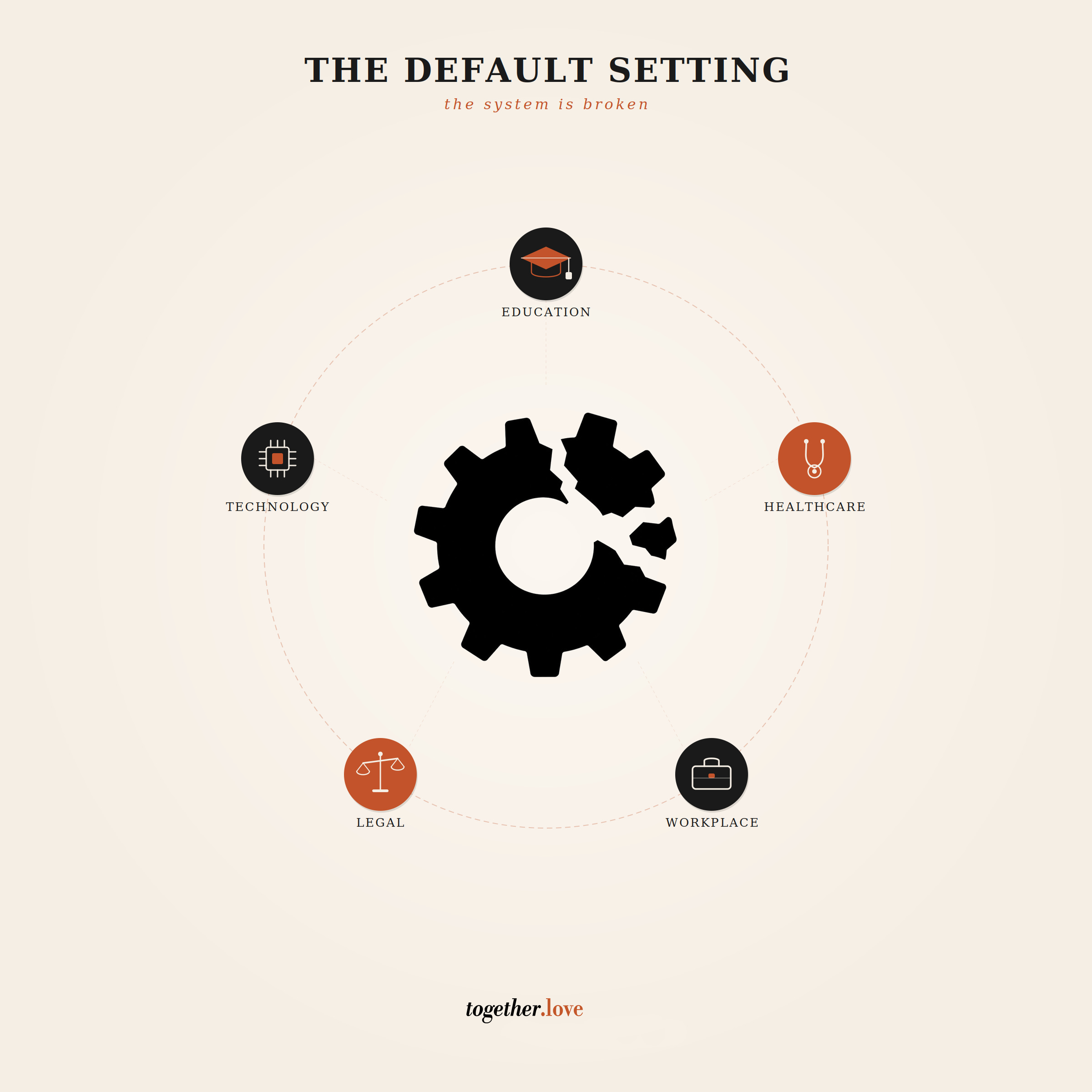
There’s a default setting running in all of us. A deeply embedded program that says male is standard and female is other. It shapes our naming conventions, our language, our laws. It’s been running for thousands of years, and most of us never question it.
But there’s a layer to this that’s harder to talk about. One that hurts more than the rest.
What happens when women internalize the default setting and enforce it against each other?
The Betrayal You Don’t See Coming
Here’s what nobody prepares you for: the moments when the person who should understand your struggle the most becomes the one who deepens it.
You expect resistance from systems built by men for men. You brace yourself for that. You develop armor for boardrooms and classrooms and waiting rooms where you know the deck is stacked.
But you don’t build armor against other women. You walk in expecting solidarity. You walk in thinking, “She’s been through it too. She gets it. She’ll have my back.”
And when she doesn’t, it cuts in a way nothing else can.
The Leader Who Looks Away
Imagine being the only woman on a technical team of over 40 people. Every meeting, every project, every hallway conversation, you are the only one. You navigate the jokes that aren’t quite jokes. The assumptions about what you can and can’t handle. The subtle and not-so-subtle signals that you are an exception to the rule, tolerated but not truly belonging.
And your director is a woman.
She made it. She broke through. She sits in the chair that proves it’s possible. And you think, surely she sees you. Surely she remembers what it felt like. Surely she understands the weight of being the only one in the room.
But she says nothing. Does nothing. Offers nothing.
The one woman with the power to acknowledge the isolation, to create space, to simply say “I see what you’re dealing with” chooses silence. Maybe she fought so hard to get where she is that she learned to stop seeing gender. Maybe she survived by becoming one of the guys and can’t afford to align herself with another woman. Maybe the default setting taught her that advocating for another woman would make her look weak, emotional, biased.
Whatever the reason, the result is the same: the woman who should be your ally becomes a bystander. And her silence reinforces the system just as powerfully as any act of open discrimination.
Research confirms this pattern. A 2016 study by Derks et al. found that women in male-dominated workplaces often exhibit three key behaviors: distancing themselves from other women, denying that gender discrimination exists, and describing themselves in masculine terms. The researchers didn’t blame these women. They identified these behaviors as a response to systemic gender inequality, not a cause of it. The system taught them that aligning with other women was a liability.
But here’s what makes this even more tragic: a 2019 study by Stoker et al. found that workplaces with more women in senior leadership roles had significantly lower rates of these behaviors. The antidote to women enforcing the code against each other is more women in power, not fewer.
The Doctor Who Doesn’t Believe You
You’re sick. You know your body. You know something is wrong. You go to a female doctor thinking she might listen more carefully, take your experience more seriously, trust your knowledge of your own body.
Instead, she’s dismissive. Impatient. You tell her you have a sinus infection. She can’t see it, so she doesn’t believe it. She treats you not like a patient describing real symptoms but like an inconvenience. Like someone who doesn’t really know what she’s talking about.
This isn’t a random bad day. This is a pattern backed by devastating data.
A 2024 study published in PNAS analyzed over 21,000 emergency department records. The findings were stark: female patients are consistently less likely to receive pain medication than male patients, even when reporting the same level of pain. Nurses were 10% less likely to even record women’s pain scores. Women waited an average of 30 minutes longer than men to receive care.
And here’s the part that cuts deepest: both male and female physicians prescribed less pain relief to women. The default setting doesn’t spare female doctors from this bias.
The Journal of the American Heart Association reported that women visiting emergency departments with chest pain waited 29% longer than men to be evaluated for possible heart attacks. One in five women report that a healthcare provider has ignored or dismissed their symptoms, according to research from Duke Health.
This isn’t ancient history. Until 1993, women were largely excluded from clinical trials entirely. Drugs were tested on men and prescribed to women. The NIH Revitalization Act had to mandate by law that women be included in medical research. Eight out of ten drugs pulled from the market by the FDA between 1997 and 2001 posed greater health risks for women than men, because they’d never been properly tested on women in the first place.
The medical system was literally built on male bodies. And women physicians trained in that system absorbed its biases along with its knowledge.
A man walks in and says “I have an infection.” He gets taken seriously.
A woman walks in and says the same thing. She gets questioned.
The doctor is a woman. And it doesn’t matter. The default setting is running.
And perhaps the cruelest irony: a 2022 study published by Harvard Health found that women treated by female surgeons had a 32% lower risk of death compared to women treated by male surgeons. Women doctors, despite the biases they’ve absorbed, still deliver better outcomes for female patients. Imagine what they could do if the default setting wasn’t running at all.
The Coordinator Who Weaponizes Your Vulnerability
You’re in a graduate program. You’re working hard, pushing through challenges, doing everything asked of you. And then life happens. You get sick. Not a little sick. Hospitalized with double pneumonia.
You share this with your program coordinator because you have to. You need accommodations. You need understanding. You trust that this private health information will be handled with discretion and compassion.
Instead, the coordinator shares your medical situation with faculty. Behind your back. Without your knowledge or consent.
You only find out by accident. A professor mentions your health challenges in conversation, and you’re confused. How does she know? You begin to explain your situation, your hospitalization, and the professor stops you.
“I know. Me and the coordinator talked about it.”
Your private health crisis wasn’t treated as something to support you through. It was treated as something to discuss. To evaluate. To weigh as evidence of whether you belonged in the program.
Both the coordinator and the professor were women.
A man misses a semester for health reasons and people say, “tough break, glad you’re back.” A woman misses a semester and suddenly her commitment is questioned, her capability is debated, her place in the program becomes a topic of conversation among people she trusted.
Her vulnerability didn’t earn her support. It earned her surveillance.
The academic research confirms this pattern extends far beyond one program. A landmark study by Boring (2017) demonstrated that female instructors receive lower evaluation scores than male instructors despite objective evidence (final exam performance) showing they teach just as effectively. Students call women “teachers” and men “professors” regardless of their actual credentials (Miller & Chamberlin, 2000). And in a revealing online experiment by MacNell et al. (2015), students rated instructors they perceived to be female lower in all categories, even when the instructor behind the screen was actually male.
The bias isn’t about competence. It never was. It’s about the default setting telling us that authority, expertise, and credibility are male. And women absorb that message too.
Why This Happens
Let’s be clear: this is not about blaming women. This is about understanding what the default setting does to all of us.
When you grow up in a system that treats women as less competent, less credible, less authoritative, you absorb those messages whether you’re a man or a woman. The programming doesn’t check your gender before it installs.
Women in positions of authority often fought incredibly hard to get there. They navigated a system that told them every day that they didn’t belong. Some survived by distancing themselves from femininity, by proving they could be “one of the guys,” by adopting the same standards and biases that were used against them.
Some learned that aligning with other women was dangerous. That it made them look soft, partial, emotional. That the safest path to power was to enforce the existing hierarchy, not challenge it.
This isn’t weakness. It’s the architecture of oppression working exactly as designed. The most efficient system of control isn’t one that requires constant enforcement from the outside. It’s one that teaches the oppressed to police each other.
That’s the default setting at its most sophisticated. It doesn’t just program men to see women as less than. It programs women to see each other as less than.
The Solidarity We Have to Choose
The default setting runs automatically. Solidarity does not. Solidarity is a choice. A daily, deliberate, sometimes uncomfortable choice.
It means the female director looks at the only woman on a team of 40 and says, “I see you. I remember. Let me help.”
It means the female doctor listens to her female patient, trusts her knowledge of her own body, and treats her pain as real.
It means the female coordinator protects a student’s private health information and asks, “What do you need to succeed?” instead of questioning whether she belongs.
It means women in positions of power using that power to dismantle the system, not maintain it. Even when it’s easier not to. Even when the default setting is whispering that other women are competition, not community.
We cannot dismantle patriarchy if we’re running its code against each other. The first step is recognizing when the default setting is active. The second is choosing to override it.
Because the system that taught us to distrust each other is the same system that benefits from our division. And the only way to break it is to refuse to enforce it.
Every time a woman chooses another woman (as her doctor, her mentor, her ally, her leader), she is rewriting the code. Every time a woman in power protects another woman instead of performing distance from her, she is changing the default.
This is not automatic. It will never be automatic. The default setting has had centuries upon centuries to embed itself. But settings can be changed. Deliberately. Consciously. Courageously.
Imagine an alien watching us. It sees a system designed to divide women from each other, to make them enforcers of their own oppression. And it asks a simple question: “If they know this system hurts them, why do they help it?”
The answer is grooming. The solution is awareness. And the path forward is one we can only walk -
Together.
Sources:
Guzikevits, M. et al. “Sex Bias in Pain Management Decisions.” PNAS, August 13, 2024.
Harvard Health. “The Dangerous Dismissal of Women’s Pain.” July 2025.
Journal of the American Heart Association. Women with chest pain wait 29% longer for heart attack evaluation.
Duke Health. “Recognizing, Addressing Unintended Gender Bias in Patient Care.” 2020.
UN Women. “Six Uncomfortable Truths About Women’s Health.” April 2026.
Harvard Health. “Does the Sex of Your Surgeon Matter?” February 2022.
NIH Revitalization Act of 1993, PL 103-43.
Boring, A. “Student Evaluations of Teaching (Mostly) Do Not Measure Teaching Effectiveness.” 2017.
Miller, J. & Chamberlin, M. Women as teachers vs. men as professors. 2000.
MacNell, L., Driscoll, A. & Hunt, A.N. Online class gender perception experiment. 2015.
Derks, B., Van Laar, C. & Ellemers, N. “The Queen Bee Phenomenon.” 2016.
Stoker, J.I. et al. Women in leadership and Queen Bee prevalence. 2019.