


Every institution has a handbook. The handbook says all the right things. It uses words like “commitment” and “zero tolerance” and “safe environment.” It lists phone numbers and reporting procedures and promises of confidentiality. It tells you that if something happens, there is a process. A fair, thorough, impartial process.
The handbook is not the playbook.
The playbook is the thing that actually happens when you report. It is not written down anywhere. It is not discussed in training. It is not listed on any website or printed in any onboarding packet. But every institution has one, and it runs the same way almost every time.
If you have never had to report something serious at work, in school, in a hospital, in any institution that holds power over your life, this will read like fiction. If you have, it will read like a mirror.
Stage 1: The Invitation
Report it. That is what they tell you.
You sit through the training. You watch the slideshow. You read the policy. You absorb the message that this organization takes these matters seriously and that there are systems in place to protect you. You are given names, numbers, links, channels. You are told that you will not face retaliation for coming forward. You are told you will be heard.
And you believe it. Not because you are naive, but because the alternative is unthinkable. The alternative is that the institution you depend on for your livelihood has no intention of protecting you. So you believe the handbook because you have to. Because showing up to work every day knowing the safety net is decorative would be unbearable.
The invitation is not a lie, exactly. It is a performance. The institution means it the way a restaurant means “the customer is always right.” It is a stated value that has almost no relationship to operational reality. But it sounds good. It looks good in print. And it gives the institution something to point to later when someone asks what they did.
They will point to it. Remember that.
Stage 2: The Absorption
You report. You sit in a room, or you write an email, or you pick up a phone, and you say the thing you have been carrying. Maybe you rehearsed it. Maybe your hands were shaking. Maybe you threw up that morning. But you said it.
And something happens. A meeting gets scheduled. Someone takes notes. Someone says “thank you for bringing this forward” with a tone that sounds like they mean it. You feel a wave of relief, maybe even gratitude. You were heard. The system is working.
Then the silence begins.
A week passes. Two weeks. A month. You ask for an update and receive a version of the same sentence: we are still looking into it. It is with counsel. These things take time. We want to be thorough.
The words change slightly each time but the meaning never does: wait. Be patient. Trust the process.
The process is not moving. The process was never designed to move. The process is a holding pattern, and its purpose is not investigation. Its purpose is the slow, steady conversion of your urgency into exhaustion.
Every day that passes without an answer, your fire dims a little. Not because you stop caring. Because the silence teaches you something: your emergency is not their emergency. The thing that keeps you up at night is an item on someone’s task list, and it is not near the top.
This stage can last weeks. It can last months. In some cases, it lasts years. The institution is not investigating. It is waiting. Waiting for you to stop asking.
Most people stop asking.
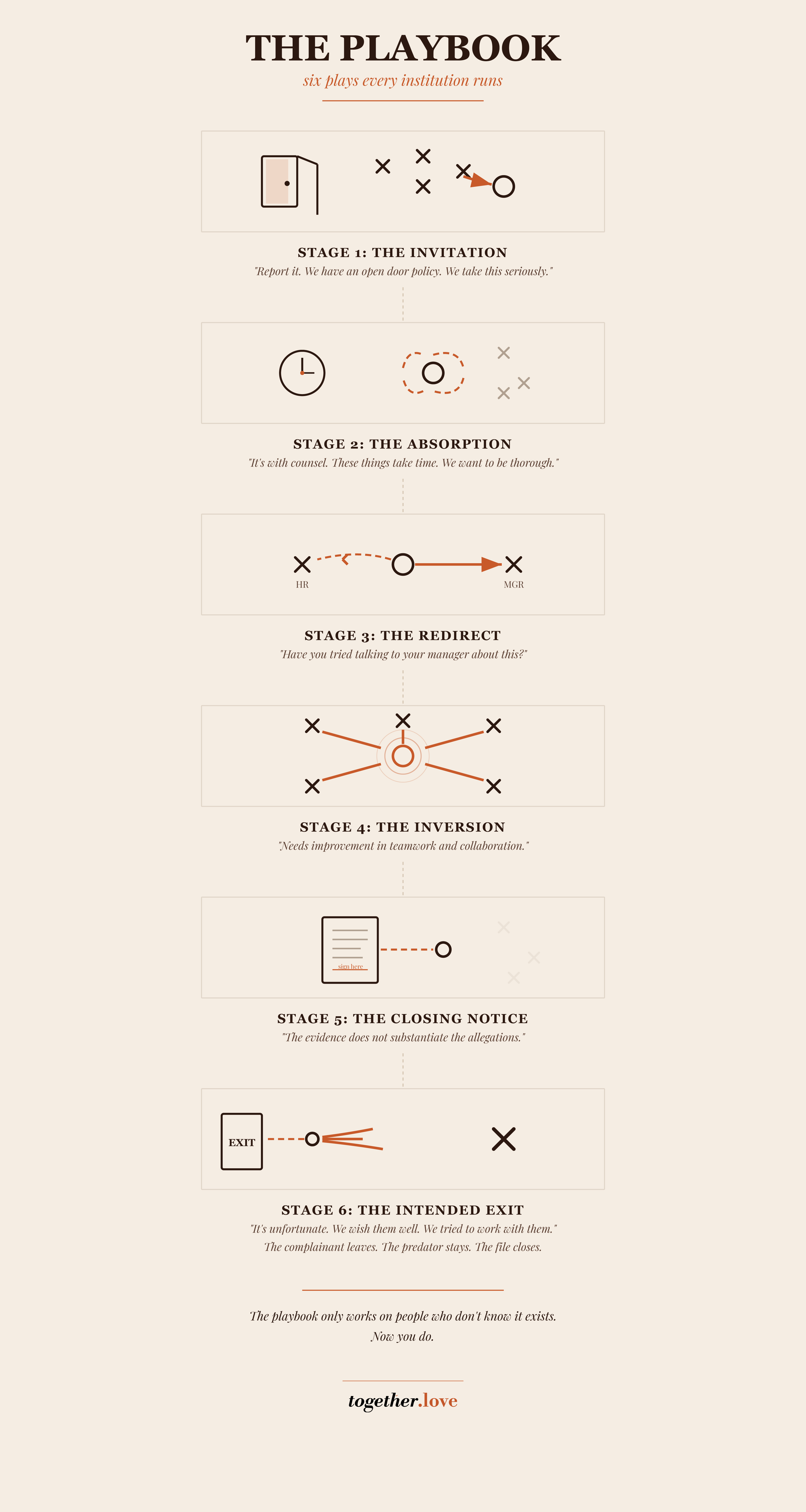
Stage 3: The Redirect
If you do not stop asking, the playbook adjusts.
You are told that the situation is being handled, but that you should also consider your own role in the dynamic. Perhaps you could be more flexible. Perhaps you could approach the relationship differently. Perhaps you should take your concerns to your direct supervisor rather than to HR.
The language is always gentle. Always framed as support. “We want to help you navigate this.” “We want to set you up for success.” “We think it might be productive for you to have a conversation with your manager about how to move forward.”
Notice what just happened. You reported harassment, discrimination, or abuse. The institution has now reframed it as a collaboration challenge. A personality conflict. A communication gap. The gravity of what you reported has been quietly drained, and what remains is a workplace disagreement between two professionals who need to find common ground.
And the person you are being redirected to? Your supervisor, your manager, the person they want you to “work it out with?” That person often witnessed what happened and said nothing. Or that person is part of the problem. Or that person has already told you, in so many words, that you are overreacting.
The redirect is not support. It is a transfer of responsibility. The institution is handing the problem back to you disguised as empowerment. “We believe in you. We think you can handle this.” What they mean is: stop bringing this to us.
Stage 4: The Inversion
This is where the playbook gets cruel.
You did not stop. You did not accept the redirect. You kept reporting, kept documenting, kept asking for accountability. And now, without anyone saying it out loud, you have become the problem.
Your persistence is reframed as aggression. Your documentation is reframed as obsession. Your refusal to “move on” is reframed as an inability to collaborate. Your boundaries are reframed as rigidity. Your trauma responses are reframed as performance issues.
A review comes in lower than last year. Not dramatically lower. Just enough to signal that something has shifted. The specific criticisms are vague: “needs to work on teamwork,” “could improve flexibility,” “should focus on being a stronger team player.” The metrics that used to earn you praise now earn you coaching.
No one says “we are punishing you for reporting.” No one has to. The playbook is subtler than that. It simply rearranges the lens through which you are evaluated until the person who reported abuse and the person who is failing to meet expectations become the same person.
The institution may even formalize this stage. A training. A webinar. A company-wide presentation on “culture” and “norms” where leadership describes the traits of problem employees without naming anyone. Words like “fragile.” “Eggshell personalities.” “Low emotional intelligence.” “They require a narrow comfort zone to succeed.” The audience is never told who these descriptions are aimed at. They don’t have to be. The person being described knows. And so does everyone who has watched what is happening to her.
The presentation will include a slide about “threats to culture.” It will list qualities like “uncollaborative,” “complacent,” “unreliable.” It will contrast them with the ideal employee: “affable,” “accountable,” “adaptable.” And somewhere in the middle, it will use the phrase “play the victim.” It will describe people who “go on the offensive with grievances.” It will talk about those with “distorted reality” and “self-delusion.”
This is not a training. It is a public sentencing delivered to an audience that has been carefully curated. The people who are in the room are being taught, in real time, how to view their colleague: not as someone who reported harm, but as someone who is the harm.
Meanwhile, the person you reported is still there. Still in meetings. Still on projects. Still smiling. Still undisturbed.
You walked into this process as a complainant. You are now a problem employee.
Stage 5: The Closing Notice
One day, a letter arrives. It might come by email. It might come by certified mail. It might come as a document attached to a calendar invite with a subject line that tells you nothing.
The letter is short. Surprisingly short, given how long you waited for it. One page, maybe two. No specifics. No witness list. No evidence reviewed. No methodology described. No findings on any individual allegation. Just a paragraph, maybe two, that says the investigation has been completed and the evidence did not substantiate the allegations under the applicable standard.
Your experience, whatever it was, has been translated into language so sterile, so deliberately empty, that it could describe anything or nothing. The most painful, frightening, violating experience of your professional life has been summarized in a sentence that reads like a form letter.
Because it is a form letter.
And at the bottom there is a signature line. They want you to sign it. To acknowledge receipt. To put your name underneath a document that says what happened to you did not happen.
There is usually a paragraph about retaliation. It tells you that you are protected from retaliation and that you should report any retaliation to the same people who just told you nothing happened. Read that twice. Let it sink in. The people who did not protect you from the original harm are now asking you to trust them to protect you from the retaliation that will follow their failure to protect you the first time.
There may also be a line about gossip. A warning about “relying on rumor or speculation.” A reminder to conduct yourself with professionalism and integrity going forward. This is directed at you. You, the person who reported a real thing that really happened, are being cautioned about spreading rumors. The institution is not just failing to validate your experience. It is warning you not to talk about it.
Sign here. Be quiet. Move on.
Stage 6: The Intended Exit
The playbook’s final stage is not a firing. It is rarely that clean or that risky. The final stage is an environment so inhospitable that leaving feels like your only option.
The silence from leadership becomes total. Emails go unanswered. Recommendations are ignored. Opportunities dry up. Applications for advancement echo meaninglessly into an empty canyon. You are not excluded from your job. You are excluded from mattering.
The people who used to engage with your ideas stop responding. The projects you built get handed to someone else. Meetings you used to lead now happen without you. Your name stops appearing in conversations about the future. You are still employed. You are no longer included.
This is not an accident. This is the architecture of constructive departure. Make someone’s daily experience so isolating, so devoid of professional oxygen, that they choose to leave on their own. No termination. No severance obligation. No unemployment claim. No paper trail. Just a quiet resignation and a forwarding address.
And when they leave, the institution drafts the narrative. A few polished sentences for leadership, for the team, for the file: 'It is unfortunate. We wish them well. Every effort was made to address their concerns. They were spoken with gracefully and privately, in an effort to avoid embarrassment. That feedback was rejected.’
The playbook worked. The predator stays. The institution survives. The file is closed.
Until the next person walks through that open door and hears the same promise.
The Part They Did Not Account For
The playbook depends on one assumption: that the complainant will eventually run out of energy before the institution runs out of patience. This is a safe bet almost every time. Institutions have lawyers, HR departments, insurance carriers, and unlimited capacity to wait. Individuals have rent, health insurance, groceries, and a finite reserve of emotional bandwidth.
But the playbook was not designed for the person who documents everything. The person who understands that memory is fragile but evidence is permanent. The person who makes sure that what was said can never be unsaid, and what was promised can always be measured against what was delivered. The person who saves every email, screenshots every text, timestamps every interaction, and builds a chronological record so detailed that the institution’s own statements can be compared against reality line by line.
The playbook was not designed for the person who files externally when the internal process fails. Who contacts the government agency whose sole purpose is investigating exactly this kind of institutional failure. Who takes the polished, confident, carefully worded position statement and dismantles it with evidence the institution did not know existed.
The playbook works in the dark. Every stage depends on the complainant not seeing the pattern until it is too late. But once someone names each stage while it is happening, the institution loses the only advantage it ever had: the assumption that no one is watching.
Institutions are not clever. They are just betting that you are not paying attention. That you will trust the process long enough for the process to wear you down.
The playbook has a weakness. It has always had a weakness.
It only works on people who do not know it exists.
Now you do.
And once you see it, you cannot unsee it. You start recognizing Stage 2 while it is still pretending to be Stage 1. You hear the redirect before it lands. You feel the inversion beginning and you name it before it takes hold. The pattern that was designed to be invisible becomes obvious, and obvious things lose their power.
The playbook was built for silence. It was built for isolation. It was built for the assumption that you would carry this alone, tell no one, and eventually buckle under the weight of fighting a machine by yourself.
So don’t.
Tell someone. Tell a friend who will believe you. Tell a family member who will stand beside you. Tell a therapist who will help you process what the institution never intended for you to survive. Call your state’s civil rights division. Call the EEOC. Consult an attorney who specializes in employment law, even if you are not sure you have a case yet. Write it down. All of it. Every date, every email, every conversation. Build your record before someone else builds one for you.
The playbook depends on you believing that you are the only one this has ever happened to. You are not. It depends on you believing that no one will care. They will. It depends on you believing that speaking up will make things worse. It might, for a while. But staying silent guarantees that nothing ever gets better, not for you, and not for the person who comes after you.
The playbook has no answer for what happens when we stop facing it alone and start facing it—
Together.
Resources
If you are experiencing workplace discrimination, harassment, abuse, or retaliation, you do not have to navigate it alone. The following resources can help:
File a Complaint
U.S. Equal Employment Opportunity Commission (EEOC) - File a charge of discrimination: https://www.eeoc.gov/how-file-charge-employment-discrimination
EEOC Public Portal - Submit an inquiry online:
https://publicportal.eeoc.gov
Find your state’s civil rights agency: Many states have their own enforcement agencies (such as the Colorado Civil Rights Division, the California Civil Rights Department, or the New York Division of Human Rights) that investigate discrimination claims. Search “[your state] civil rights division” to find yours.
Find Legal Support
Workplace Fairness - Information on employee rights and attorney referrals:
https://www.workplacefairness.org
National Employment Law Project (NELP):
https://www.nelp.org
Your state or local bar association can provide referrals to employment law attorneys, and many offer free initial consultations.
Find a Therapist
Psychology Today Therapist Directory - Search by specialty, location, and insurance. Filter for trauma-focused therapists: https://www.psychologytoday.com/us/therapists?category=trauma-and-ptsd
Open Path Collective - Affordable therapy ($30-$80/session) for individuals without adequate insurance:
https://openpathcollective.org
Crisis Support
RAINN (Rape, Abuse & Incest National Network) - 24/7 support for survivors of sexual violence:
https://www.rainn.org
or call 1-800-656-4673
988 Suicide and Crisis Lifeline - Call or text 988, available 24/7
The Trevor Project - Crisis support for LGBTQ+ individuals:
https://www.thetrevorproject.org
or call 1-866-488-7386
Trans Lifeline - Peer support for the trans community: 1-877-565-8860
Educate Yourself
Workplace Bullying Institute - Research and resources on workplace abuse:
https://workplacebullying.org
Know Your Rights: https://www.eeoc.gov/know-your-rights