

Last Monday, a research team out of Temple University and the University of Oregon published a study in the Journal of Neuroscience that most people will never hear about. They should. Buried in its findings is the outline of the most important public health story of this century, and I want to walk you through why.
The study nobody is talking about yet
O’Brien, Murty, and colleagues asked a question the field has been circling for years: we know childhood trauma is linked to anhedonia, the clinical name for a diminished ability to feel pleasure and motivation. But does trauma cause anhedonia directly, or does something else determine who develops it?
Their answer, from a human cohort studied with fMRI: it depends on the wiring. Participants with childhood trauma and disrupted reward pathways stemming from the hippocampus experienced significant anhedonia, specifically the anticipatory kind: an impaired ability to look forward to rewards and pursue them. Participants with comparable trauma but intact hippocampal pathways largely did not. The trauma alone was not the whole story. The trauma plus the circuit disruption was.
That is a mechanism. And in medicine, a mechanism is the difference between a condition you endure and a condition with coordinates.
The senior author noted this is among the first work linking the hippocampus, a region we file under “memory,” to apathetic behavior in humans. The team’s stated next goal: identify a target in the hippocampus that can restore the capacity for pleasure in people with childhood trauma.
Read that sentence again. A target. For restoring pleasure. In trauma survivors. That is not a wellness aspiration. That is a treatment roadmap.
The wiring damage is not evenly distributed
Here is what the new study connects to, and why it landed so hard for me personally. A body of neuroimaging research going back two decades has shown that childhood maltreatment does not damage the brain uniformly. Different kinds of harm leave different signatures.
Systematic reviews of trauma-subtype neuroimaging have found that sexual abuse in childhood is specifically associated with reduced hippocampal volume, while other maltreatment types, like emotional maltreatment, do not show the same hippocampal effect. Meta-analytic work has found that the association between childhood maltreatment and reduced hippocampal volume is driven substantially by studies of sexual abuse, with the largest volume differences appearing in sexual and physical abuse subtypes. Teicher and colleagues have documented type-specific effects so precise they are hard to read without flinching: survivors of childhood sexual abuse show measurable thinning in the exact region of the somatosensory cortex that represents the body areas involved. The brain does not just record that harm happened. It records what kind.
So assemble the chain: certain kinds of childhood abuse preferentially disrupt the hippocampus. Disrupted hippocampal reward pathways are what convert a trauma history into lifelong anhedonia. And the field is now openly hunting for a hippocampal target to reverse it.
I know this terrain from the inside. I have spent years reverse-engineering my own reward system, reading this literature the way other people read the sports page, because the science was slowly catching up to something I understood experientially long before the fMRI studies existed. Watching the mechanism get published feels less like news and more like vindication of what I have always felt internally: trauma causes neurological changes, and certain types of trauma are especially heinous in just how life-destroying they truly are.
Wonder is what plasticity feels like
Let me offer a piece of this puzzle from the lived side, one I have never seen stated plainly in a journal.
Think back to childhood, to the moments you were safe. The world was magical. Not metaphorically: everything was saturated, interesting, worth investigating. Every child reports this. Every adult remembers it, usually through the ache we call nostalgia.
Neuroscience has a dry name for the childhood brain state: heightened plasticity, wide-open critical periods, a dopamine system that fires hard on novelty in a world where everything is novel. I want to propose that these are not two separate facts. The felt magic of childhood is what high plasticity is like from the inside. A brain that weights every prediction error heavily, that treats each input as news rather than confirmation, experiences the world as luminous. An adult brain running mature predictive compression experiences the same street as a rerun: seen it, filed it, next.
If that is right, then nostalgia is partly the memory system flagging the contrast, recalling experiences encoded under a high-gain regime from within a low-gain present. And for those of us whose reward circuitry took developmental damage, the delta is not bittersweet. It is bereavement. The baseline fell further than aging alone can explain.
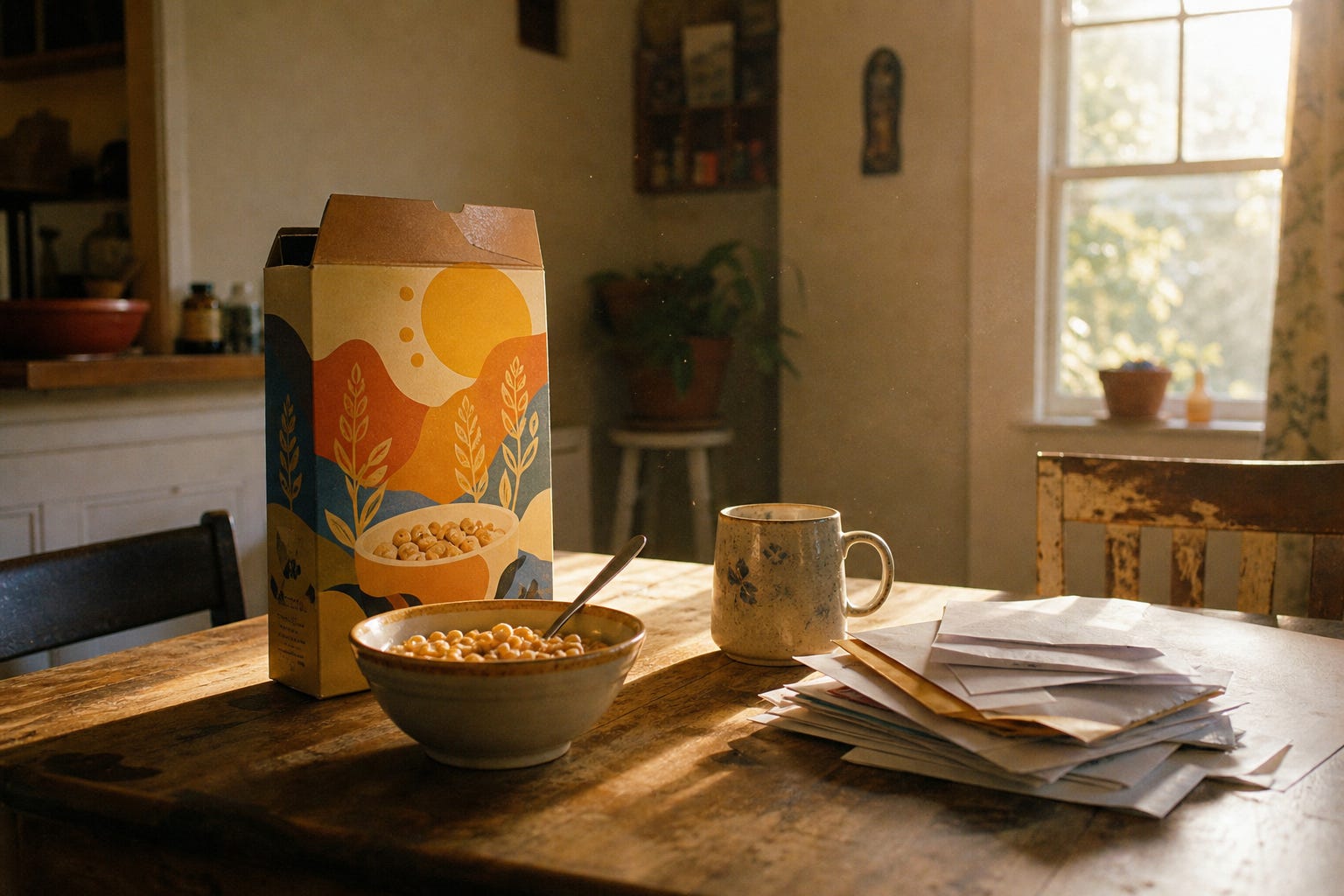
It also means something hopeful about the treatments coming: if they genuinely reopen plasticity, the window may not be silent. It may feel, mildly and ambiently, like the tuning coming back. Like the cereal box being interesting again.
This is bigger than any one diagnosis
Now widen the lens, because reward dysregulation does not stay in one diagnostic lane. Consider what sits downstream of a reward system that cannot pay out on ordinary life:
Substance use disorder, which the self-medication model has long understood as a dopamine-deficient system seeking exogenous correction. Compulsive eating and a meaningful share of obesity, where food, sugar, and refined carbohydrates serve as the most available reward stimulus on earth. The motivational collapse that shadows ADHD. Chronic rage and irritability, which ride on a system that cannot generate enough baseline positive affect to buffer frustration. And the largest group of all: the millions who never meet criteria for anything, who simply live their whole lives in gray and assume those various shades of gray are the only colors the world comes in.
We already have accidental proof that these travel together. The GLP-1 drugs, developed for diabetes and weight, act on receptors that sit on reward circuitry, and the reports pouring in alongside the weight loss describe quieted alcohol cravings, reduced smoking, less compulsive spending. Randomized trial evidence is now emerging that semaglutide reduces alcohol craving and consumption in alcohol use disorder. “Food noise” going silent turned out to be reward noise going silent. Millions of people are walking around right now with pharmacological evidence that the reward system is one dial, and that turning it moves half a dozen “separate” conditions at once.
The GLP-1s manage the signal. They do not repair the substrate. But they are the population-scale demo that this is the meat of the story.

What the cure will actually look like
Here is my prediction, reasoned from the mechanisms: the eventual treatment will not be a pill alone or a procedure alone. It will be a protocol. A plasticity-opener paired with directed relearning inside the window it opens.
Every genuinely exciting result of the past decade has that two-part shape. Ketamine produces rapid anti-anhedonic effects alongside a burst of synaptogenesis in precisely the hippocampal and prefrontal territory this literature implicates, and the effect fades when nothing consolidates the new growth. MDMA-assisted therapy posted strong phase 3 results for PTSD not because the molecule heals but because it appears to reopen something like a critical period during which the therapy does the rewiring. Landmark work from Gül Dölen’s lab has shown that psychedelics broadly function as reopeners of critical periods in the brain. And a newer lineage of engineered compounds, the tabernanthalog family, aims to deliver the plasticity without the trip, which is what would make restoration scalable, insurable, and available from a family doctor rather than a supervised clinic.
Add one more delivery mechanism for the entrenched cases: transcranial focused ultrasound, which can now reach deep structures like the hippocampus non-invasively with millimeter precision, and which is already in early trials for mood circuits. The new study’s “identify a target in the hippocampus” meets its instrument.
Open the window. Do the directed work through it: something closer to physical therapy for the reward system than talk therapy. Consolidate. I would call the category substrate restoration, as against symptom management, which is what nearly everything we currently offer amounts to.
And to be precise about the word cure: this is not erasure, but rather restoration. The history does not un-happen. Cure, here, means the person is no longer dopamine-seeking, because the endogenous system finally pays out on ordinary life. Music has depth again. A project pulls instead of having to be pushed. Tuesday feels like something.
Two or three generations
Run the arc forward. Childhood maltreatment sits upstream of a staggering share of chronic human suffering; the original Adverse Childhood Experiences research mapped its dose-response relationship to addiction, depression, disease, and early death decades ago. But the most important property of this damage is that much of its transmission is environmental. Traumatized nervous systems raise children with a dysregulated toolkit, and the wound photocopies itself forward.
Repair the substrate at scale and the photocopy chain breaks. The first treated generation parents differently. The second grows up in households run by restored people. By the third, the population-level baseline has moved. That is not utopian arithmetic; it is what removing an environmentally transmitted damage vector does. Everyone benefits, including the people who thought they were fine, the same way everyone benefited when we stopped putting lead in gasoline.
The resistance will be real, and it will lose
I will not pretend this arrives unopposed.
At the household level, the resistance is already documented in the coercive-control literature: abusers select for vulnerability, cultivate dependence, and actively sabotage a victim’s therapy, medication, and support systems, because a regulated, confident person is one who leaves. A world with restoration protocols is a world where some partners will “not believe in” the treatment and some parents will block it. That fight will be fought household by household, the way it always has been.
At the societal level, the opposition will mostly be quieter and more boring than a villain: chronic-management economics out-lobbying cure economics, insurers dragging on coverage, regulatory timidity around anything psychedelic-adjacent, and moral panics about medicating away character.
But watch how the GLP-1 story is unfolding, because it is the preview: enormous institutional reluctance, and the drugs are winning anyway, because tens of millions of people can feel the difference and will not give it back. Restoration will win the same way. Not by converting the resistant, but by the treated being so visibly better off that resistance becomes embarrassing. You do not have to defeat the vampires. You just cure enough of the town.
The good-prognosis cohort
One last thing, for the people who have been doing this work the long way: the therapy, the EMDR, the reading, the deliberate daily rebuilding of a reward system that never got its fair start.
The window-openers, when they arrive, will amplify whatever work walks through them. The people who respond best to these protocols will be the ones who show up having already spent years doing the manual version on equipment the clinic had not installed yet.
If that is you: you’re not behind. You are the good-prognosis cohort, and we’ll get there the same way that we survived:
Together.
Related Reading
The Calendar Reminder — the lived, physiological account of what childhood mistreatment does to a body. This piece is the mechanism and the repair roadmap; that one is the other half of the argument.
What They Call a Personality Conflict — how institutions minimize and rename harm to avoid confronting it. The societal-scale resistance this piece predicts, documented at the workplace scale.
Sources
O’Brien, K.J., Elliott, B.L., O’Shea, I., Schiffman, J., Mittal, V.A., Ellman, L.M., & Murty, V.P. “Functional integrity of mesolimbic-hippocampal circuits is associated with anhedonia in individuals with early life stress.” Journal of Neuroscience (2026). DOI: 10.1523/JNEUROSCI.0274-26.2026. https://www.jneurosci.org/content/early/2026/08/06/JNEUROSCI.0274-26.2026 — Society for Neuroscience press summary, August 17, 2026: https://www.eurekalert.org/news-releases/1139511
Cassiers, L.L.M., et al. “Structural and Functional Brain Abnormalities Associated With Exposure to Different Childhood Trauma Subtypes: A Systematic Review of Neuroimaging Findings.” Frontiers in Psychiatry (2018). https://www.frontiersin.org/journals/psychiatry/articles/10.3389/fpsyt.2018.00329/full
Teicher, M.H., Anderson, C.M., & Polcari, A. “Childhood maltreatment is associated with reduced volume in the hippocampal subfields CA3, dentate gyrus, and subiculum.” PNAS (2012). https://www.pnas.org/doi/10.1073/pnas.1115396109
Teicher, M.H., & Samson, J.A. “Annual research review: Enduring neurobiological effects of childhood abuse and neglect.” Journal of Child Psychology and Psychiatry (2016). https://doi.org/10.1111/jcpp.12507
Heim, C.M., Mayberg, H.S., Mletzko, T., Nemeroff, C.B., & Pruessner, J.C. “Decreased Cortical Representation of Genital Somatosensory Field After Childhood Sexual Abuse.” American Journal of Psychiatry (2013). https://psychiatryonline.org/doi/10.1176/appi.ajp.2013.12070950
Felitti, V.J., et al. “Relationship of Childhood Abuse and Household Dysfunction to Many of the Leading Causes of Death in Adults: The Adverse Childhood Experiences (ACE) Study.” American Journal of Preventive Medicine (1998). https://www.ajpmonline.org/article/S0749-3797(98)00017-8/fulltext
Duman, R.S., Aghajanian, G.K., Sanacora, G., & Krystal, J.H. “Synaptic plasticity and depression: New insights from stress and rapid-acting antidepressants.” Nature Medicine (2016). https://pmc.ncbi.nlm.nih.gov/articles/PMC5405628/
Mitchell, J.M., et al. “MDMA-assisted therapy for severe PTSD: a randomized, double-blind, placebo-controlled phase 3 study.” Nature Medicine (2021). https://www.nature.com/articles/s41591-021-01336-3
Nardou, R., et al. (Dölen lab). “Psychedelics reopen the social reward learning critical period.” Nature (2023). https://www.nature.com/articles/s41586-023-06204-3
Cameron, L.P., et al. (Olson lab). “A non-hallucinogenic psychedelic analogue with therapeutic potential.” Nature (2020; print 2021). https://www.nature.com/articles/s41586-020-3008-z
Hendershot, C.S., et al. “Once-Weekly Semaglutide in Adults With Alcohol Use Disorder: A Randomized Clinical Trial.” JAMA Psychiatry (2025). https://pubmed.ncbi.nlm.nih.gov/39937469/
Pechtel, P., & Pizzagalli, D.A. “Effects of early life stress on cognitive and affective function: an integrated review of human literature.” Psychopharmacology (2011). https://link.springer.com/article/10.1007/s00213-010-2009-2