

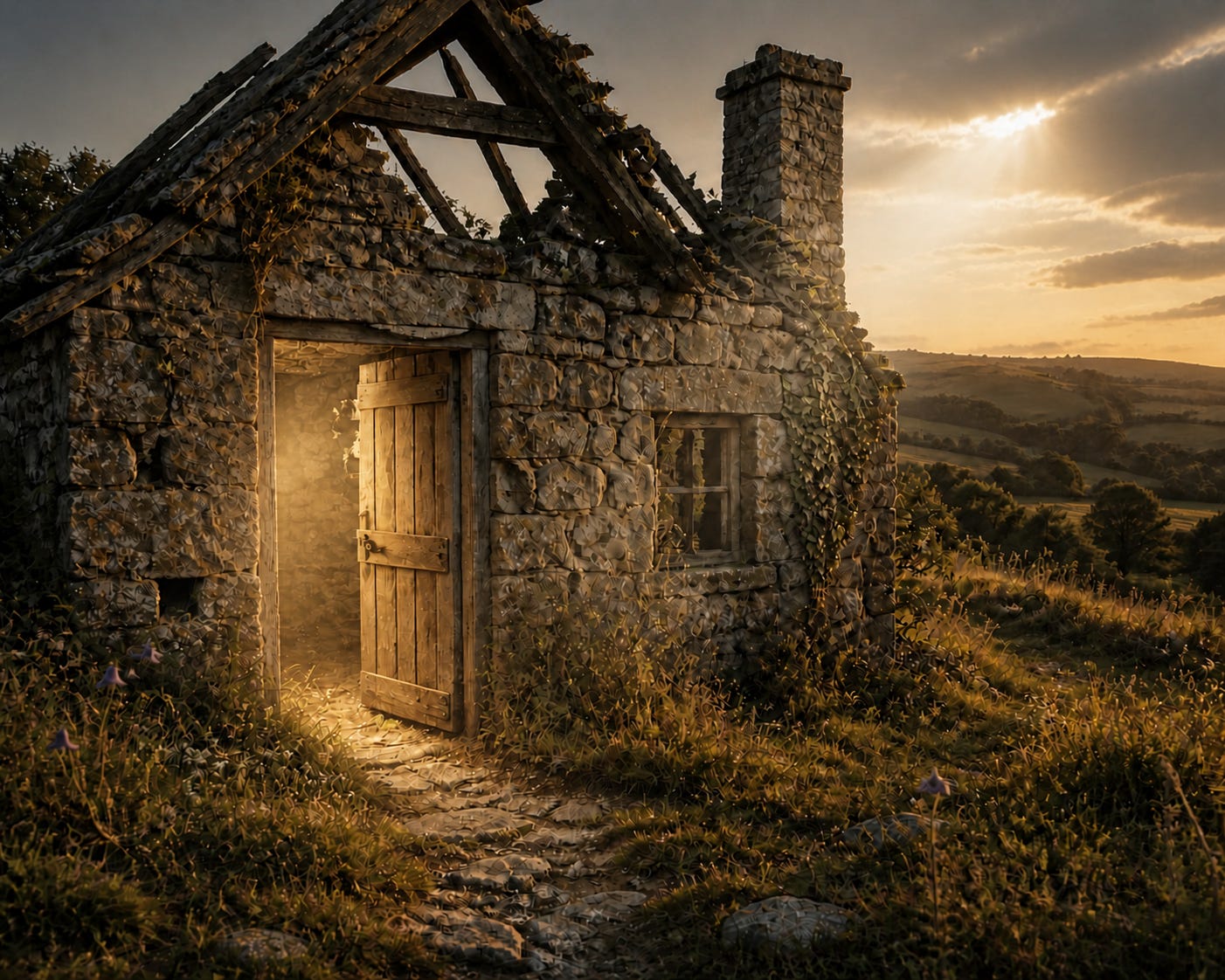
There is a cottage somewhere in the English countryside. It is long gone now, its timbers returned to the earth centuries ago, its exact location lost. No historian has mapped it. No plaque marks where it stood.
A man lived there. We do not know his name.
We know he worked. We know he came home. We know that when he opened the door, someone was glad to see him. We know his children knew the sound of his footsteps before he reached the threshold. We know that when he was sick, someone stayed. When he was afraid, someone listened. When he laughed, it was answered.
We know that when he took his last breath, he was not alone.
And we know, because love teaches this without language, that he believed he was the wealthiest person who ever lived.
He was right.
Twelve miles from that cottage, or a hundred, in a palace built to project power across the known world, Henry VIII was dying.
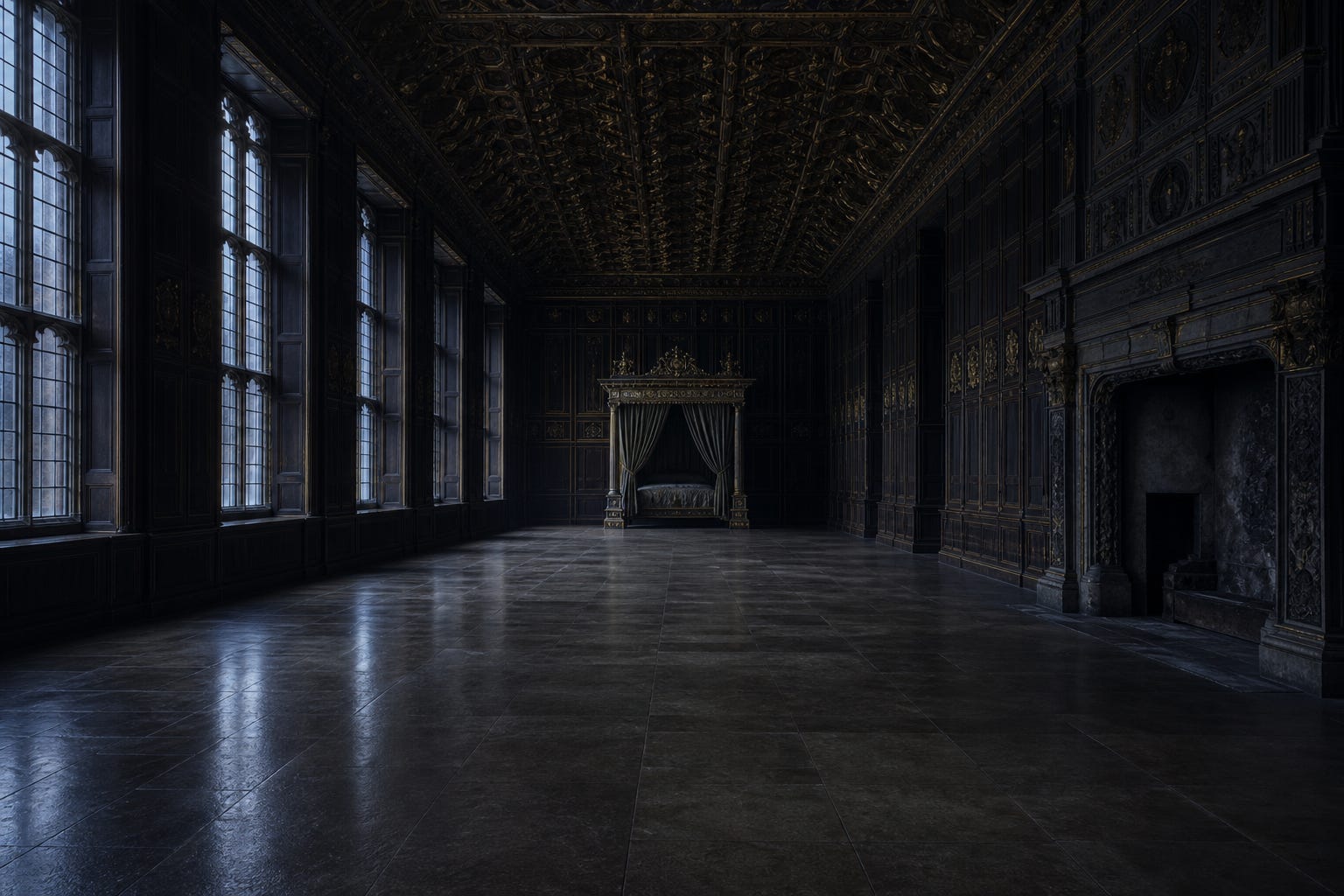
He was fifty-five. His body, once celebrated as the most magnificent in Europe, had been failing for years. Ulcers on his legs had wept for over a decade. He was carried from room to room. The man who had jousted, hunted, and danced, who had been called the most handsome prince in Christendom, could no longer walk the length of his own chambers.
Six wives. Two beheaded. Two divorced. One dead in childbirth. One who survived him, largely because she had learned to stop disagreeing.
He broke an entire nation from the Catholic Church. Not over theology. Because the Pope would not grant him permission to discard a wife who failed to produce a male heir. He dissolved the monasteries. Seized their land, their wealth, their libraries. Executed friends, advisors, and anyone whose loyalty flickered. Thomas More. Thomas Cromwell. Thousands of unnamed others whose crimes amounted to proximity.
All of it in pursuit of a legacy. A son. A continuation of himself that would prove his life had meaning.
His son was nine when Henry died. The Privy Council was already positioning for succession before his body cooled. They delayed announcing his death for three days. Not out of grief. To consolidate power. The people in that room were not holding vigil. They were holding position.
There is a widely told account that after his body was laid in state at Syon Abbey, a former monastery he himself had dissolved, his coffin burst overnight and dogs were found at the remains. Historians dispute whether it literally happened. But the story endured because it matched what people already knew: that power, left to consume a person long enough, eventually consumes the body too.
Here is what power does when love has never entered the room: it fills the space.
Not because power is strong. Because the emptiness is unbearable.
Henry did not behead Anne Boleyn because her crimes were real. He did not dissolve the monasteries because he had a principled critique of monastic life. He did not execute Thomas More, one of the finest minds in Europe, because More had wronged him beyond forgiveness.
He did these things because he was starving. And power was the only food he recognized.
Look at the pattern. Every wife was an audition for love that Henry could not receive, because he had never learned to see another person as real. The moment a wife failed to reflect his needs back to him, she became disposable. Not a partner. A mirror. And when the mirror cracked, he shattered it and reached for another.
This is not a story about a king. This is the story of what happens when someone has never been loved well enough to learn that other people exist on their own terms. When that person has no power, the damage is contained. When that person commands a nation, the damage reshapes civilization.
Every seizure of land was an attempt to feel full. Every execution was an attempt to feel safe. Every marriage was an attempt to feel chosen. And every single one failed, because power cannot do what love does. It can compel presence. It cannot create it.
The man in the cottage did not need a reformation.
He did not need a dynasty or the Pope’s permission or the fear of a nation to know that his life had weight. He did not need to behead anyone to feel secure in his own home. He did not need to dissolve a single institution to believe he mattered.
He had arms around him when the dark came.
That was enough. That was everything.
And here is the part that should stop you: he knew it. He was not ignorant of his wealth. He did not need history to validate what he held. He felt it in the way his wife’s breathing steadied when he climbed into bed. He felt it in the way his children ran to the door. He felt it in the quiet after supper, when no one needed anything from anyone and everyone stayed anyway.
He knew exactly what he had. He knew it was more than any king would ever hold.
We remember Henry. We study him. We build television empires around his wives and fill university syllabi with his reign and debate his legacy in seminar rooms with oak tables and leather chairs.
We do not remember the man in the cottage.
But the man in the cottage was never trying to be remembered by strangers. He was trying to be remembered by the people in the room. His children spoke his name to their children. His wife carried him forward in the way she loved them, in the lessons she repeated, in the way she taught them that showing up is the most valuable thing a person can offer another person.
Henry’s legacy is a cautionary tale. The cottage man’s legacy is a family.
One of those legacies is still breathing. You can find it in every home where someone opens the door and is glad to see who walks through it. In every bed where someone reaches across at 2 AM to make sure the other person is still there. In every kitchen where someone makes a plate for the person running late, because of course you make a plate.
That legacy does not require a crown. It does not require a throne or a reformation or the terror of a nation to sustain itself.
It requires exactly what it has always required: the many, for the one.
Henry VIII had six wives, twelve palaces, and the power to reshape a civilization.
The man in the cottage had a door that someone was always glad to see him walk through.
One of them was the richest man in England.
May we all learn the true road to riches.
Together.
Sources & Notes
Sources & Notes — each source linked to the actual page:
Tudor Society, “31 January 1547: Henry VIII’s Death Is Announced” → https://www.tudorsociety.com/31-january-1547-henry-viiis-death-announced-edward-vi-proclaimed-king/
Historic Royal Palaces, “Henry VIII, Terrible Tudor?” → https://www.hrp.org.uk/hampton-court-palace/history-and-stories/henry-viii/
Historic Royal Palaces, “Sir Thomas More: Execution of a Saint” → https://www.hrp.org.uk/tower-of-london/history-and-stories/sir-thomas-more/
The National Archives, “The Dissolution of the Monasteries” → https://www.nationalarchives.gov.uk/explore-the-collection/explore-by-time-period/early-modern/the-dissolution-of-the-monasteries/
St George’s Chapel, Windsor, “Henry VIII’s Final Resting Place” → https://www.stgeorges-windsor.org/wp-content/uploads/2017/08/BackgroundNotesHenryVIII.pdf
Nancy Bilyeau, “Debunking the Myths of the Death of Henry VIII” → https://tudorscribe.medium.com/debunking-the-myths-of-the-death-of-henry-viii-3f5d7d69f5ad
Related Reading
The Button Dilemma — Why people choose each other when it counts, even when the math says they won’t.