

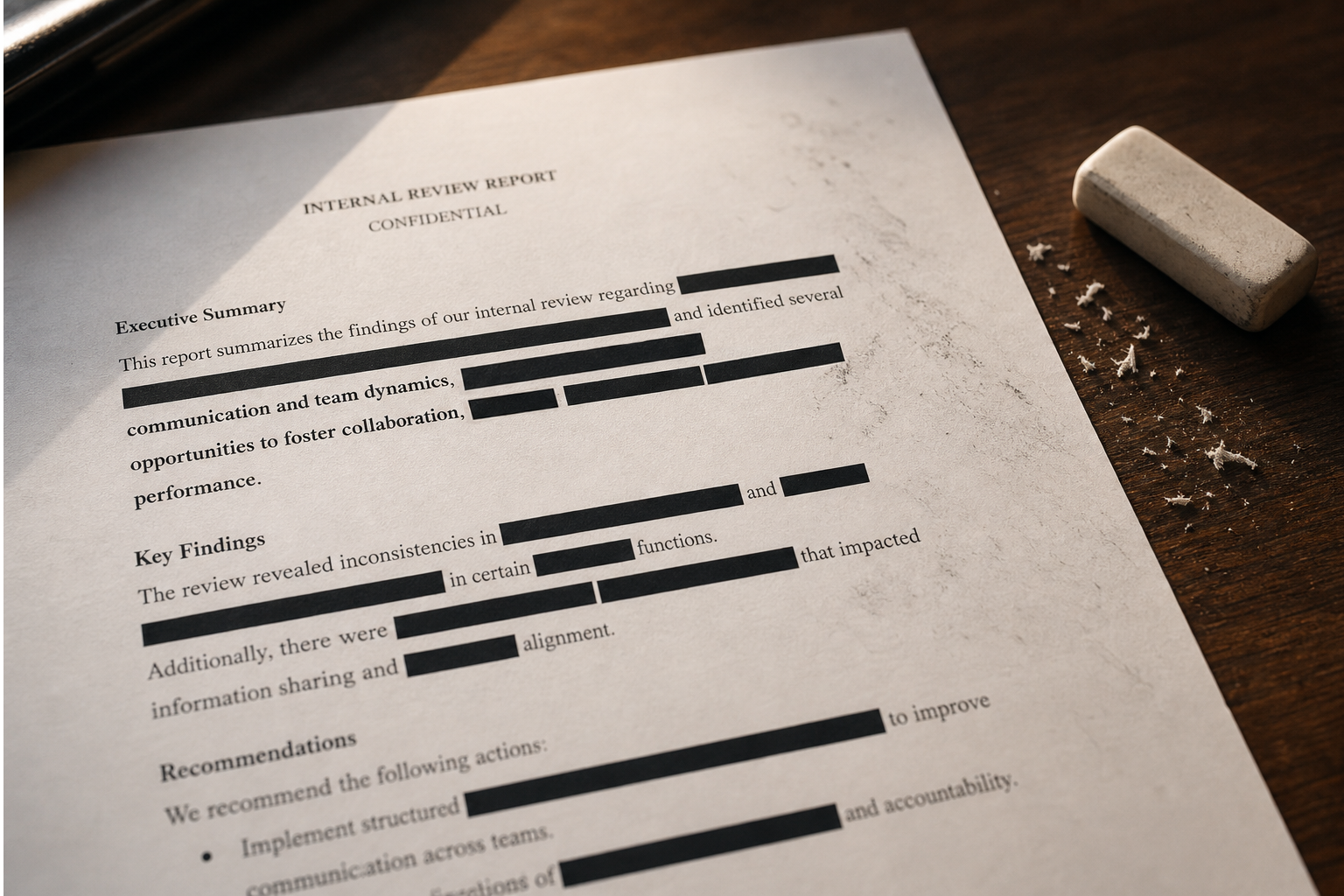
There is a sentence that gets written when institutions decide they are done looking. It reads like this: The investigation has concluded that there are opportunities to address communication and team dynamics to support collaboration and to foster an environment of trust. However, the evidence does not substantiate the raised allegations under the preponderance of the evidence standard.
Read it again.
Notice what that sentence does. It takes documented patterns of workplace harm, the kind that organizational psychologists have studied for decades, and reclassifies them. Credit theft becomes a communication gap. Being systematically talked over in meetings becomes a team dynamics issue. Having your professional reality rewritten in real time becomes an opportunity to foster trust.
This language is not accidental. It is a technology. And if you have ever been on the receiving end of it, you already know what it feels like to watch your lived experience get translated into something unrecognizable.
This article is for the people living inside that translation. Not to diagnose the person causing harm, but to name the behaviors, cite the science, and give you a concrete playbook for protecting yourself when the institution won’t.
The patterns have names
Organizational psychology has been studying these behaviors for decades. They are not personality quirks. They are not styles of communication. They are documented, measurable, and they cause quantifiable harm.
Credit appropriation. Researchers define this as the act of claiming ownership of another person’s contributions or inflating one’s role to appear more capable (Weaver, 1986; Ellis et al., 2002). A 2022 study published in Frontiers in Psychology found that when leaders claim credit for employees’ work, it triggers what researchers call relative deprivation, a psychological state where the targeted employee experiences diminished motivation, reduced organizational commitment, and increased intent to leave (Chen et al., 2022). A separate 2026 study from the University of Toronto, involving more than 1,600 participants, confirmed that credit theft produces measurable anger rooted in the loss of ownership, recognition, and opportunity (Zweig et al., 2026). This is not a feelings problem. It is a structural one.
If someone is routinely presenting your ideas as theirs, summarizing your work without attribution, or absorbing your contributions into their own deliverables, you are not imagining it. The research says this behavior is common, deliberate, and damaging.
Conversational dominance. The foundational research here goes back to Zimmerman and West (1975), who found that in mixed-gender conversations, 96% of interruptions were initiated by the male speaker. Subsequent research from George Washington University found that men interrupted 33% more often when speaking with women than with other men. A Harvard Kennedy School study confirmed that both men and women exhibit more verbal dominance in male-dominated groups, and that individuals who interrupted were actually rated lower on leadership qualities by their peers (Karakowsky et al.). The data is consistent: interruption is not enthusiasm. It is a power display. And it disproportionately targets women and people of color in professional settings.
If you find yourself unable to finish a sentence in meetings, if your points are routinely restated by someone else moments later without attribution, if you have stopped raising ideas because they will either be ignored or absorbed, these are not quirks of group conversation. These are patterns with a research base.
Reality revision. A 2026 paper in Frontiers in Psychology established workplace gaslighting as a distinct organizational construct, different from bullying, incivility, or simple disagreement. The researchers defined it as behavior oriented toward gaining advantage or exerting control, with the potential to produce psychological, relational, reputational, or occupational harm (Storm and Muhr, 2023). A 2025 interdisciplinary review in the Journal of Organizational Behavior found that gaslighting often goes unrecognized precisely because it operates through charm and plausible deniability rather than overt hostility (Kincaid et al., 2025). The gaslighter does not yell. They reframe. They do not deny events outright. They introduce just enough uncertainty to make you question whether you remember correctly.
If you walk out of meetings unsure whether what you remember actually happened, if written records consistently contradict your experience, if raising concerns is met with, “that’s not what occurred,” you are not confused. You are being managed.
What happens when you report it
Psychologist Jennifer Freyd coined the term DARVO to describe a common response pattern when harmful behavior is reported: Deny, Attack, Reverse Victim and Offender. Her research shows that when bystanders observe DARVO without prior education about it, they are measurably swayed. They begin to doubt the person who raised the concern. But when bystanders are educated about the pattern in advance, its persuasive power drops significantly (Harsey and Freyd, 2020).
Freyd’s related concept of institutional betrayal describes what happens when the organization itself fails to respond supportively, or actively sides with the person causing harm. A 2023 study published in PLOS ONE found that institutional courage, the organizational opposite of betrayal, actually buffers against the health effects of workplace harassment and increases employee commitment (Smidt, Adams-Clark, and Freyd, 2023).
This means the institution’s response is not a secondary event. It is the event. When an investigation concludes that documented, patterned behavior is simply a communication issue, that conclusion is itself a harm. And it has a name.
The protection playbook
You cannot control what someone else does in a meeting. You cannot control what an institution decides to call it afterward. But you can build a record that exists outside anyone’s ability to rewrite it, and you can take steps that position you to advocate for yourself no matter what conclusion gets written into a file.
Document in real time. After every meeting where your contributions are at risk, send a follow-up email summarizing what was discussed and who contributed what. Use language like, “Per our discussion, I want to confirm that [your name] proposed [idea] and the group agreed to [outcome].” This is not passive aggression. This is the knowledge repository that the University of Toronto researchers identified as the most effective intervention against credit theft. It creates a written record with a timestamp that no one can retroactively edit.
Use the stated-for-the-record technique. In meetings, when you see a contribution about to be absorbed, name it in the moment. “I want to build on what [colleague] just said” or “To go back to the point [colleague] raised.” This is verbal documentation. It forces attribution into the room’s shared memory before anyone can rewrite it.
Build amplification alliances. The women on President Obama’s White House staff, outnumbered two to one by male aides, developed a strategy they called amplification. When a woman made a key point, other women repeated it and credited her by name. The practice forced recognition and made credit theft structurally impossible. You do not need institutional power to do this. You need one ally who agrees to echo your contributions and credit you by name, and you do the same for them.
Communicate in writing whenever possible. Verbal conversations can be rewritten. Emails cannot. When a decision is made verbally, follow up in writing. When an agreement is reached in a hallway, memorialize it. When your work is assigned, confirm the scope and deliverables in an email. You are not being difficult. You are being precise.
Keep a personal record outside company systems. Maintain a contemporaneous log of events, dates, and specifics on your own device, your own email, your own cloud storage. Include what was said, who was present, and what the outcome was. Contemporaneous notes carry significant weight in any formal proceeding because they were written at the time, not reconstructed from memory later. If you are ever asked to substantiate a pattern, you will have one.
Know the difference between conflict and conduct. A personality conflict is two people who do not get along. What we are describing here, credit theft, conversational dominance, reality revision, and institutional minimization, is conduct. It has documented psychological effects, measurable organizational costs, and, in many cases, legal implications. Do not accept a frame that reduces conduct to conflict. The language matters. Use it precisely.
Know what to do when the internal process fails. Not every investigation is conducted in good faith. When witnesses are identified and never contacted, when patterns are documented and relabeled as personality differences, when the conclusion reads as though it was written before the process began, you are not looking at a flawed investigation. You are looking at the absence of one. File with your state’s civil rights division. File with the EEOC. Consult an employment attorney. The internal process is not the only process, and its conclusions are not the final word. You have the right to pursue external remedies, and pursuing them does not make you difficult. It makes you someone who refused to accept a rewrite of your own experience.
What an equitable workspace actually requires
Individual protection strategies are necessary, but they are not sufficient. An equitable workspace is not one where targeted employees have to build elaborate defense systems just to have their work recognized. It is one where the structures themselves prevent these patterns from taking root.
That means contribution tracking systems where ideas are documented and attributed at the point of origin. It means meeting norms that include structured turn-taking and explicit attribution practices. It means investigation processes that distinguish between interpersonal friction and patterned conduct. It means institutional courage: the willingness to act on what is found, even when acting is uncomfortable.
If your organization concludes that documented, patterned behavior is simply a communication issue, that conclusion tells you something important. Not about the investigation’s findings, but about the institution’s capacity for honesty about itself.
When the label erases the harm
There is something that needs to be said plainly.
Sometimes what an institution calls a team dynamics issue is not a team dynamics issue. Sometimes the behavior that was reported has a legal definition. Sometimes it is assault. Sometimes it is harassment that spanned months or years, corroborated by multiple witnesses, and those witnesses were never contacted. And sometimes the institution’s conclusion, written in the same measured, clinical language it would use for a scheduling disagreement, lands on the person who reported it like a second violation.
Because that is what it is. Freyd’s research on institutional betrayal documents that the institution’s failure to respond, or its active decision to minimize, produces harm that is distinct from and in many cases compounds the original harm. Targets of institutional betrayal report higher rates of anxiety, depression, and PTSD symptoms than those whose institutions responded with accountability (Smith and Freyd, 2014). The betrayal does not replace the original violation. It layers on top of it. And it carries a particular cruelty, because the person who came forward did so believing that the system existed to help.
If you are the person inside that experience, hear this: the institution’s refusal to name what happened does not un-name it. A conclusion written in euphemism does not change the nature of the event. You know what happened. The witnesses know what happened. The paperwork is a choice the institution made about itself. It is not a statement about you.
Support is not optional
You may be reading this and thinking that what you experienced was not severe enough to warrant outside support. You may be telling yourself that you can handle it, that it is over now, that you have already moved past it.
Rethink that.
When your professional reality has been systematically distorted, when you have been told that what you experienced did not happen, when an institution you trusted wrote a conclusion that erased your account, the psychological weight of that does not simply dissipate because the process ended. It accumulates. And it deserves attention.
Sexual assault and harassment that happen in the workplace are rarely met with the same validation as assault that happens on a street or in a parking lot. There is no crime scene tape. There is no immediate language of violation available to you. Instead, there is a meeting room, a hallway, a shared office, and an HR process that may ultimately call it a collaboration opportunity. But the harm is not diminished by the setting. A workplace assault carries everything that any assault carries, the violation, the fear, the disorientation, and then layers on top of it the daily requirement to return to the place where it happened and perform as though it didn’t. The absence of external validation does not mean the harm was less severe. It means the systems around you failed to name it.

Support can look like a lot of things. It can look like an honest conversation with a friend. Not venting, but telling the truth to someone who will hold it with you. It can look like confiding in a trusted colleague, someone who may have seen the same patterns, as long as you stay grounded in facts and do not let the conversation drift into territory that could be reframed against you. It can look like finding a therapist who understands workplace trauma, specifically one familiar with institutional betrayal and DARVO, because not every therapist will know those terms and you deserve one who does. It can look like attending a support group for survivors of sexual assault or harassment. Your experience belongs in those rooms. The fact that it happened at work does not make it a different category of harm. It makes it a less acknowledged one.
The point is this: the institution may have decided the matter is closed. That does not mean your healing is complete, and it does not mean you have to carry this alone. You are not required to absorb an institution’s failure to act as evidence that what you experienced does not matter. It matters. You matter.
You deserve a workspace that does not require you to build a paper trail just to prove your own contributions exist. You deserve an institution that knows the difference between a personality conflict and a pattern of harm. And you deserve support that matches the weight of what you have been through, not support that has been pre-approved by the entity that failed you.
Until those things arrive, protect yourself. Document everything. Tell the truth to people you trust. And know that you were never meant to carry this alone. None of us were. So let’s carry it…
Together.
Sources
Chen, S., Li, D., Yang, C., Zhang, X., & Hou, L. (2022). The idea is mine! An empirical examination on the effect of leaders’ credit claiming on employees’ work outcomes. Frontiers in Psychology, 13.
Freyd, J.J. (2014). Institutional betrayal and institutional courage. Freyd Dynamics Lab, University of Oregon.
Harsey, S. & Freyd, J.J. (2020). Deny, Attack, and Reverse Victim and Offender (DARVO): What is the influence on perceived perpetrator and victim credibility? Journal of Aggression, Maltreatment, & Trauma, 29, 897-916.
Karakowsky, L., McBey, K., & Miller, D. Gender, perceived competence, and power displays: Examining verbal interruptions in a group context. Harvard Kennedy School Gender Action Portal.
Kincaid, L. et al. (2025). An interdisciplinary review of the gaslighting literature and future research agenda. Journal of Organizational Behavior.
Smith, C.P. & Freyd, J.J. (2014). Institutional betrayal. American Psychologist, 69(6), 575-587.
Smidt, A.M., Adams-Clark, A.A., & Freyd, J.J. (2023). Institutional courage buffers against institutional betrayal, protects employee health, and fosters organizational commitment following workplace sexual harassment. PLOS ONE, 18(1).
Storm, S. & Muhr, S.L. (2023). Workplace gaslighting: Conceptualization, development, and validation of a scale. Frontiers in Psychology, 14.
Zweig, D. et al. (2026). Properly crediting employees for their ideas is key to building a strong workplace culture. Journal of Occupational and Organizational Psychology.
Zimmerman, D.H. & West, C. (1975). Sex roles, interruptions, and silences in conversation. In B. Thorne & N. Henley (Eds.), Language and Sex: Difference and Dominance.
Related Reading
Delayed Reporting — The math people do before they speak up, and why the system has no right to hold the silence against them.
The Playbook — A survivor’s advocacy handbook. Documentation frameworks, institutional process navigation, and what to do when the system fails you.
Resources
If you or someone you know is navigating workplace harassment, assault, or institutional betrayal, these organizations offer free, confidential support.
National Sexual Assault Hotline — RAINN Call 800-656-HOPE (4673) | Chat at rainn.org/hotline | Text “HOPE” to 64673
Confidential support for domestic violence and abuse — National Domestic Violence Hotline Call 800-799-7233 | Text “START” to 88788 | Chat at thehotline.org
Free, 24/7 crisis counseling via text — Crisis Text Line Text HOME to 741741
Research and resources on institutional betrayal, DARVO, and building institutional accountability — Center for Institutional Courage
The foundational research on Deny, Attack, Reverse Victim and Offender, including how to recognize and reduce its impact — Jennifer Freyd’s DARVO Research
File a workplace harassment or discrimination charge — U.S. Equal Employment Opportunity Commission Call 800-669-4000
Education, research, and advocacy for targets of workplace abuse — Workplace Bullying Institute
Workers’ rights research and policy advocacy — National Employment Law Project
Search for therapists by specialty, including workplace trauma, PTSD, and institutional abuse — Psychology Today Therapist Finder