

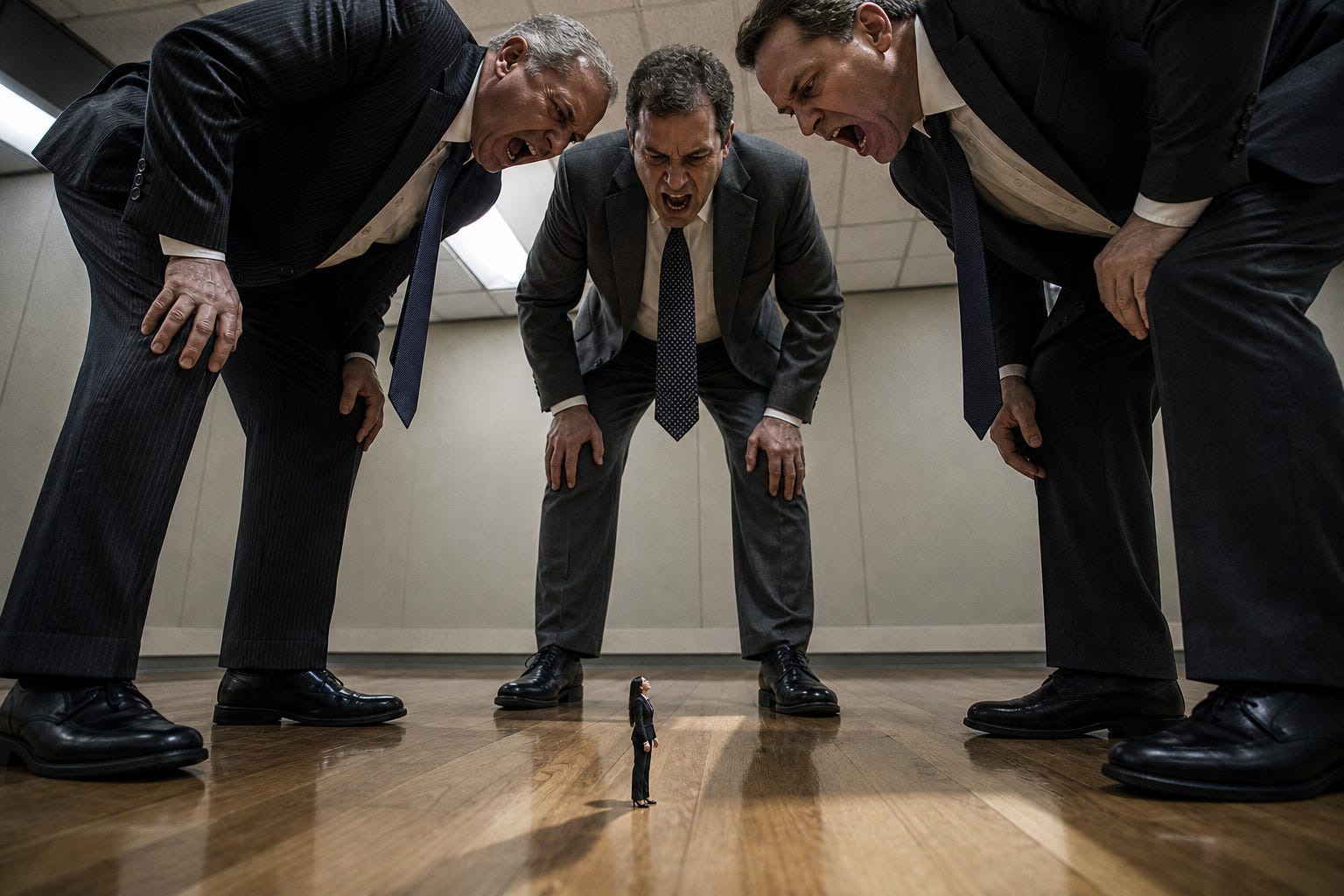
The meeting notification pops up in the center of my screen, telling me that it starts in fifteen minutes. He will be there. I will see his face. I will hear his voice.
My heart is already pounding. I know without checking, because I have checked before: 125 beats per minute, sitting still, in an ergonomic chair, in a quiet room with calm music playing, in no danger at all.
The nausea rises next. It always does. I reach for the nausea medication and find the bottle empty, and the frustration I feel is not about the vomiting. It is about the timing. So I let it rise. I hope it happens in the next minute or two. If my body is going to do this, I need it done fast, so I can rinse my mouth, fix my face, and join the meeting on time.
The part I want you to sit with is the logistics. Not the panic. I was not falling apart. I was scheduling my falling apart, the way you slot in a dentist appointment. I had a system for this, and a medication for this, because this was not the first time and would not be the last.
That was a while ago. The vomiting has stopped since I began to learn to stand in my own power. But the discomfort of those memories has not.
I want to tell you why my body did this. But to do that, I have to tell you what my body remembers.
The ledger
Here is what makes no sense on paper. By the time that notification hit my screen, I had done the work. Not the Instagram version of the work. Four and a half years with a therapist who specialized in grief and trauma. EMDR, the real thing, bilateral stimulation with the light bar and the paddles in my hands.
If you have never done EMDR, the process itself does not hurt. You hold the memory in your mind and you follow a light moving left to right, paddles pulsing in your palms, and it feels almost mundane while it is happening. The bill comes later. We learned to schedule my sessions on Thursdays, because by Friday evening the rage would arrive, then the grief, then crying that came from somewhere below language, then an exhaustion so total it felt chemical. I needed the weekend to get to the other side of it. We planned for my healing the way you plan for surgery recovery, because that is what it was.
And it worked. I need you to know that it worked, because everything I am about to say depends on it. The memories that used to play in technicolor, 4K, front and center, faded to black and white. Muted. Pixelated. Filed where they belonged instead of projected on every wall. My startle response dropped so drastically that my therapist used it as a progress marker. I started falling asleep like a person instead of a sentry (I know a thing or two about being a sentry, but that is a different article). The pull toward the things that hurt me, the bad food, the bad habits, the abusive relationships, the quiet self punishment, loosened its grip.
I walked into therapy ten pounds underweight, having night terrors, breaking down crying in the middle of a college class, buried in complicated grief. I walked out with my life back.
So explain the calendar reminder.
Explain why, years later, a man’s name in a meeting list could take a body that had done all of that work and run it straight back to 125 beats per minute and a bathroom floor.
Bessel van der Kolk gave the answer its most famous phrasing: the body keeps the score. Trauma does not live in your memories. It lives in your nervous system, your hormones, your immune response, the actual wiring of your brain. Severe abuse literally re-routes neural pathways. It changes how your body produces and processes cortisol, and it makes that change early, while everything is still under construction. Therapy can refile the memories. The body keeps its own ledger, and it does not always accept edits on your timeline. Maybe those changes can be undone all the way. Maybe it takes fifty years after the healing is done for the full residue of childhood trauma to be washed off. Nobody can tell me for certain.
What I can tell you is where a ledger like mine gets opened. Mine was opened before I could read.
Property
Children were property in this country. That is not a metaphor. It is legal history.
For most of America’s existence, a child had no standing of their own under the law. What happened inside a family was the family’s business, and the family, for legal purposes, meant the adults. In 1874, a ten year old girl named Mary Ellen Wilson was being beaten and starved in a Manhattan apartment, and the church worker who found her discovered there was no one to call. No child protection agency existed. Not in New York. Not anywhere on earth. The person who finally forced the case into court was Henry Bergh, the founder of the ASPCA. The animal welfare movement had to step in, because we had built protections for animals before we built any for children. The world’s first child protection organization was founded the following year, as a direct result.
And do not imagine the country sprinted to catch up after that. The crawl took a century, and it is not finished. The first durable federal law against child labor did not pass until 1938, and only after the Supreme Court had struck down an earlier attempt, ruling that Congress had no business interfering with the market for children’s work. Doctors did not even have a clinical name for what kept showing up on their x-rays until 1962, when a pediatrician named C. Henry Kempe published The Battered Child Syndrome and forced his own profession to admit that the fractures were not accidents. Mandatory reporting laws only spread through the states in the mid 1960s. The first federal child abuse law, CAPTA, arrived in 1974.
Hold those dates up against your own birth year. If you were born before 1974, you were born into a country that had no federal child abuse law at all. In 1977, the Supreme Court ruled that paddling schoolchildren does not count as cruel and unusual punishment, and most of the state bans on school paddling only arrived in the late 1980s and 1990s. If you were born in the 80s or the 90s, the law was still catching up to you while you were being raised. Some of it never caught up. Survivors from those decades have only gained the right to sue their abusers within the last several years, as states finally reopened statutes of limitations that had quietly expired while victims were still learning how to say out loud what had been done to them.
We like to tell ourselves this is all a long time ago. Beating children in schools is still legal in 17 states. Sweden banned all corporal punishment of children in 1979, and dozens of countries have followed since. In the United States, hitting your own child remains legal in all fifty.
And the culture matched the law. Think about how normal it was, and in too many places still is, for a family to have that one creepy uncle. Every family seemed to have one. He was a punchline in sitcoms, a whispered warning between siblings and cousins, an empty chair next to him you learned to avoid taking. Nobody treated his presence as an emergency, because a world that classified children as property had already decided whose comfort counted. You do not remove a grown man from the guest list to protect property. You manage the property around him.
My family ran that system with precision. I can describe it exactly, because I was briefed on it as a child.
Before family parties, each of us kids would be pulled aside by a parent. My cousins got the same talk I did. It usually went something like this:
Your Uncle Jack is coming to the party tonight when he gets off from work. I want you to stay away from him, but don’t be mean. And if he asks for a hug, hug him. But don’t hang around or talk to him for more than a minute. If he tries to get you alone, say no. But if he still finds a way to do anything to you that’s wrong, I want you to come to me right away and let me know.
Read it again, and take it fully in. Or not, if it’s too traumatic for you. But if you have the stomach for it, examine what this speech admits without ever saying it. Notice that nobody explains why a child must stay away from Uncle Jack. The reason was so well known it did not need words. He was known. He was named. He was invited anyway. “Stay away from him, but don’t be mean.” A child instructed to manage her own molestation risk through etiquette. “If he asks for a hug, hug him. But don’t hang around or talk to him for more than a minute.” Hug the predator correctly, and keep the conversation under sixty seconds. “If he tries to get you alone, say no.” The refusal was delegated to the child. And if he “still finds a way.” Still. Finds a way. Every adult in that family understood he was actively trying, and that a child’s no might not stop him.
My mother gave me that speech. She was also one of the adults abusing me at home.
So understand what that speech actually was. It was not protection. It was jurisdiction. The reporting channel routed directly back into the system of harm. Come to me right away, said the person I also needed protection from. And the uncle was not even blood. He was her sister’s husband, a predator who married in, and the family’s response was not to remove him. It was to reorganize the children around his presence.
If that architecture sounds familiar, it should. It is the same architecture I have seen since, in workplaces and institutions: everyone knows, nothing is done, and the complaint process delivers you to the people causing the harm. I did not learn that pattern from any policy or employee handbook. I learned it at a family party, decades before anyone handed me an org chart.
The arithmetic
Here is what that system costs, counted in the only currency that matters more with every year that passes:
My brother died at 48. My uncle at 48, maybe 49. My aunt at 56. My mother at 60. Another aunt at 62. And just recently, an uncle at 65.
In a few weeks, I’ll be turning 54... have I done enough of the work to avoid my immediate family’s fate? Time will tell.
The CDC and Kaiser’s landmark study on Adverse Childhood Experiences (ACE) found that people with six or more of them die, on average, nearly twenty years earlier than people with none. Not from the abuse itself. From what the abuse does to a body that spends decades marinating in its own stress chemistry. The heart disease, the cancer, the addiction, the immune systems that give out. The body keeps its own ledger, and eventually it collects, and much sooner than most for people with a high ACE score.
My mother smoked until she was 50 and died of lung cancer at 60, and everyone was satisfied to call it the smoking. The smoking was never the whole story. Her body had cortisol dumped into it nearly every day of her life, long after she was gone from the environment that started it. I know how that works from the inside. A flashback is enough. For all I know, she had one the day before she died.
I will not pretend these deaths are simple to grieve. Some of the people on that list were harmed and did harm. Both things are true, and I am not going to look away from either one. That is the whole discipline of this piece: no looking away.
And that discipline cuts toward me too. What was every one of those calendar reminders doing to my own body? Every spike to 125 beats per minute, every flood of nausea, every cortisol dump in a quiet room with calm music playing. Was each one cutting more of my life short, the same way every cigarette shortened my mother’s lifespan? Because that is what this kind of abuse actually is when you strip away the polite language. It is not an interpersonal difficulty. It is a slow dosing. Every one of those meetings was a cigarette I never chose to smoke.
The choice
Which brings me back to the man in the calendar reminder. A nervous system does not respond to a name on a screen that way without reasons. Mine had years of them.
And yet. Years ago, he disclosed to me that his own ledger looks like mine. Opened early, with entries in virtually every column. His body almost certainly sends him reminders too. Harmed first, harming after: he belongs on the same page as some of those in my family. He grew up and chose to become the thing that was done to him.
This is the part where I refuse to hand out the excuse, so let me say it plainly. Trauma explains cruelty. It does not authorize it. At a certain point, every one of us who was hurt stands at the same fork, and we choose whether we are going to be cruel in return. The choice is rarely dramatic. It arrives in small moments, when the cruelty feels right, feels justified, feels good. That feeling is exactly the test. You have to have enough wherewithal to pull back and say: wait. I don’t care that it feels good. I don’t care that I look right from where I’m standing. The thing I want to do will hurt someone, and that is not justifiable. Look closer. Choose again.
That is the beginning. Not the end, the beginning. Once you can catch yourself wanting to be cruel and hold yourself accountable for the wanting, the real work can start.
My mother stood at that fork too. She had the same exit I did, and she did not take it, and her children paid for that every day. Her early death does not purchase absolution for what she did with her own words and hands, and her suffering does not either. I can grieve her and hold her accountable in the same breath. I am doing it right now.
The exits
So what actually breaks this? Because it does break. I am proof, and I am not rare, I am just loud.

Therapy breaks the loop from the inside. EMDR and a good trauma therapist are not self care garnish. They are the intervention that takes what happened to you out of the projector and puts it in the archive, and in doing so, they interrupt the transmission of cruelty to the next person in line. When I say most of this country needs EMDR and a good therapist, I am not being cute. I am describing remediating our social infrastructure.
But I need to be honest about how I found that intervention, because the path is part of the problem. I was 29 years old before anyone correctly diagnosed my PTSD. It took 17 more years of skips, hops, and jumps before I sat across from the therapist who finally brought me the most healing. A therapist at my university mentioned EMDR in passing. That was the thread. I went hunting for someone who practiced it, and that hunt is one of the reasons I am the person writing this article instead of another number in the arithmetic.
None of that was an orchestrated system. It was a series of fortunate accidents, and a whole lot of stubbornness. I am telling you plainly that this is the common story, not the exception; decades between the wound and its actual name. More years between the name and the treatment that works. My healing should never have depended on luck, and neither should yours. That is why this piece is so specific about the diagnosis, the modality, and the directory waiting at the bottom of this page. If naming the road can shorten someone’s 17 years to 17 days of searching, then this article has done its job.
Travel and education break the loop from the outside, because abuse inside a sealed system does not register as abuse. It registers as normalcy. And normalcy offers a certain type of comfort that is very enticing and difficult to stray from.
I can tell you when my own loop first cracked. I was around 13, spending time at friends’ houses, when I started noticing that their homes ran on different physics. Nobody was being managed. Nobody got briefed before dinner. There was an air of property in my house, and that air simply did not exist in theirs. By 16 or 17 I was comparing patterns that refused to match, thinking, that’s odd. I don’t understand what’s happening here. That confusion was the beginning of everything.
Then I joined the Army and landed in South Korea, and the crack became a break. The world I found was nothing like the world that had been described to me growing up, and I started questioning everything. Once that starts, it does not stop on command. What the Army gave me and what it cost me is its own story, for another article.
The first time you stand in a family, a town, a country where children are not treated the way you were treated, something irreversible happens: what was done to me stops looking like how the world simply is. It starts looking like a decision somebody made. And decisions can be judged. They can also be refused.
One exit inward, one exit outward. A therapist, a passport, a classroom. What that prescription would mean for an entire country full of unread ledgers is its own article, and I intend to write it. For now, I will say only this: cruelty is made, not born. It is made young, in sealed rooms, and nobody shows those children the door.
We can all be the ones who show those children the door. We can be the ones who refuse to give that speech to another generation of children waiting for a party to start.
As for me, there will be another calendar reminder someday, and my body will answer it the way my body answers. The difference is that I finally understand what it is saying. It is not warning me about my future. It is remembering my past, and I survived my past. So maybe my heart will race, and I will let it, the way you let an old friend finish telling a hard story.
And when the story is finished, I will take a breath and get on with my day. I have come to a new understanding of an old lesson: people should hold no more power over me than the memory they became. Healing, it turns out, was never about the alarm going silent. It was about the alarm losing its authority. What was done to me is still written in the ledger. It no longer gets to write my future. My body will catch up on its own timeline. It always has. And if you are still struggling with your ledger, those of us further along the healing road will be here, ready to help you stand in your own power —
Together.
Related Reading
More from together.love on how these systems work, and how we take them apart:
What They Call a Personality Conflict
Resources
If you are ready to find a therapist trained in the therapy I describe in this piece, the EMDR International Association keeps a directory of certified clinicians you can search by location: EMDRIA.
If you are a child in danger right now, or an adult who knows one, there are counselors available around the clock who will help you figure out the next step: Childhelp National Child Abuse Hotline, 1-800-422-4453.
If you are a survivor of sexual violence and want to talk to someone who understands, trained support is free and confidential, any hour: RAINN National Sexual Assault Hotline, 1-800-656-4673.
If you want the science behind what trauma does to the body, the book that changed the field is Bessel van der Kolk’s The Body Keeps the Score.